Showing posts with label Spatial Computing. Show all posts

Thursday, May 28, 2026

Beyond VR: How Spatial Computing Turns Tribal Knowledge Into Digital Workforce Intelligence

Why industrial training simulators are becoming safer, smarter, and more scalable ways to prepare workers for complex equipment, hazardous environments, and mission-critical procedures.

Spatial Computing Simulation-Based Training: Beyond VR
Beyond VR: How Spatial Computing Training Turns Tribal Knowledge into Digital Workforce Intelligence

Industrial training is facing a new kind of pressure.

Experienced operators are retiring. Younger workers are entering the field with different expectations for how they learn. Equipment is becoming more complex. Safety expectations are increasing. And many organizations are being asked to do more with fewer highly experienced people available to train the next generation.

This is not just a staffing issue. It is a knowledge-transfer issue.

For decades, many industrial organizations have relied on a combination of classroom instruction, manuals, shadowing, and on-the-job learning. Those methods still matter, but they are not always enough for today’s equipment, procedures, and workforce challenges. A new operator may need to understand machine controls, jobsite awareness, equipment inspection, emergency procedures, team coordination, and the consequences of small mistakes — often before they have meaningful access to the real equipment.

That is where spatial computing-based simulation training becomes valuable.

Spatial computing is often associated with VR headsets, AR glasses, and mixed-reality devices. But the real value is not the headset. The real value is the ability to turn physical equipment, operational procedures, jobsite environments, safety risks, and expert decision-making into interactive 3D training systems.

For industrial organizations, this means workers can practice before they perform. They can make mistakes without damaging equipment, interrupting operations, or putting themselves and others at risk. They can repeat difficult procedures until they build confidence. And trainers can measure not just whether someone completed a course, but how they actually performed.

Spatial Computing Simulation-Based Training: Lower Costs and Less Downtime
Lower Costs and Less Downtime

That shift, from passive instruction to measurable practice, is why spatial computing is becoming an important tool for workforce development.

The workforce problem is also a training problem

The U.S. manufacturing sector alone may need as many as 3.8 million workers between 2024 and 2033, with roughly 1.9 million of those roles at risk of going unfilled if workforce challenges are not addressed, according to reporting on research from Deloitte and The Manufacturing Institute. The same reporting notes that digital skills, including simulation software skills, are becoming increasingly important in manufacturing environments.

That matters because the skills gap is not only about finding people. It is about preparing people.

Industrial work often depends on expertise that is difficult to capture in a manual. Experienced operators know what a machine should sound like. They know where not to stand. They know which steps are easy to overlook, which shortcuts are dangerous, and which abnormal conditions require immediate attention. Much of that knowledge is learned through years of experience.

The challenge is that organizations cannot always wait years for new workers to develop that judgment.

Simulation-based training helps close that gap by turning expert knowledge into structured, repeatable training experiences. A simulator can recreate the machine, the controls, the surrounding environment, the required sequence of actions, the common mistakes, and the consequences of those mistakes. Instead of relying entirely on one-on-one instruction from senior personnel, companies can preserve and scale that expertise across locations, teams, and generations of workers.

Spatial Computing Simulation-Based Training: Faster Workforce Onboarding
Faster Workforce Onboarding

Beyond “VR”: the simulator is the training system

It is tempting to think of spatial computing training as simply “putting someone in VR.” But that misses the point.

The headset, display, desktop interface, touchscreen, HoloLens, or physical controls are only the delivery mechanism. The real intelligence is in the simulation model underneath.

A strong industrial training simulator can include:

  • Accurate 3D equipment models
  • Realistic control behavior
  • Physics-based machine movement
  • Guided procedures
  • Fault conditions and emergency scenarios
  • Performance tracking
  • Instructor tools
  • Team-based multiplayer training
  • Scoring and assessment
  • Scenario variation
  • Integration with physical controls or hardware mockups

This is where spatial computing becomes more than an immersive visualization. It becomes a digital training environment.

A trainee does not just look at a machine. They operate it. They inspect it. They respond to problems. They experience the results of their decisions. And over time, the simulator can produce data that helps trainers understand where individuals or teams need more practice.

Recent industrial VR safety-training research supports this direction. A 2024 study of VR-based safety training for refinery hazards described VR as a way to provide risk-free immersive practice for emergency protocols, equipment handling, spatial navigation, and evacuation procedures in high-risk industrial settings.

That is the key idea: simulation creates a safe place to practice unsafe, expensive, rare, or difficult-to-reproduce scenarios.

What this looks like in real industrial training

ForgeFX has seen this pattern across a wide range of simulation projects: the most valuable training applications are not generic 3D experiences. They are purpose-built systems designed around specific equipment, specific learners, and specific operational goals.

For example, the JLG AccessReady Fusion XR simulator demonstrates how spatial computing can help train operators on construction equipment such as aerial work platforms and telehandlers. These machines are expensive, physically large, and often used in environments where operator awareness is essential. A simulator gives trainees an opportunity to become familiar with controls, movement, positioning, and safe operation before stepping into the real equipment.

The Somero S22EZ Laser Screed VR Training Simulator shows a similar benefit in concrete construction. Laser screed operation requires an understanding of the machine, the surface being placed, control inputs, and the workflow of the job. In a real-world setting, training time can be limited by equipment availability, job schedules, material cost, and the risk of mistakes. A VR simulator allows operators to practice the procedure in a focused environment where repetition is possible.

The Global Ground Support Aircraft Deicing Simulator shows how simulation training can support aviation ground operations. Deicing requires operators to work around aircraft, equipment, weather constraints, fluid application procedures, holdover time considerations, and team coordination. A simulator can recreate aircraft types, deicing vehicles, environmental conditions, and multi-user scenarios in a transportable format.

And in heavy equipment projects for OEMs such as John Deere, Komatsu, and Caterpillar, simulation helps manufacturers train operators, technicians, dealers, customers, and sales teams on equipment that may be expensive, difficult to transport, or not yet widely available in the field.

Different industries. Different equipment. Same underlying value: spatial computing makes complex work easier to teach, safer to practice, and easier to measure.

The safety benefit: practice the dangerous moments before they happen

No simulator should be treated as a magic solution for safety or compliance. Safety outcomes depend on culture, supervision, procedures, engineering controls, maintenance, and many other factors.

But simulation can play an important role in safety training because it allows organizations to train for moments that are difficult to practice in real life.

Spatial Computing Simulation-Based Training: Safer Training
Safer Training for High-Risk Tasks

A worker can practice responding to an equipment fault. An operator can learn what happens when a load is positioned incorrectly. A team can rehearse communication during a time-sensitive procedure. A trainee can experience a hazardous scenario without real-world consequences.

This matters because many industrial mistakes happen not because people lack information, but because they lack experience applying that information under realistic conditions.

Traditional training can explain what to do. Simulation lets people practice doing it.

That distinction is especially important for younger workers and new hires. Many digital-native learners are accustomed to interactive environments where they can experiment, receive feedback, and repeat tasks until they improve. Spatial computing-based simulation training aligns well with that learning style while still supporting the rigorous procedural standards required in industrial environments.

The operational benefit: train without disrupting the operation

Industrial training often competes with production.

Real equipment may be in use. A jobsite may not be available. A machine may be too expensive to dedicate to training. A physical training setup may require travel, instructors, fuel, materials, consumables, or downtime. Some scenarios may be too dangerous or rare to recreate safely.

Simulation helps reduce those constraints.

A simulator can be deployed in a training center, at a trade show, on a desktop, in a VR headset, in a transportable hardware station, or across multiple locations. Trainees can practice repeatedly without putting hours on machines, consuming materials, or waiting for ideal field conditions.

For OEMs, this creates an additional advantage. A training simulator can become part of the customer experience. It can help dealers demonstrate equipment. It can help customers understand safe operation. It can support onboarding for new machine models. It can reduce the burden on field trainers and make training more consistent across regions.

That is why more OEMs are viewing simulators not just as internal training tools, but as competitive advantages. A well-designed simulator can help a customer get value from equipment faster.

The measurement benefit: training becomes data

One of the most important advantages of simulation-based training is that it can produce measurable performance data. In a classroom, completion is often measured by attendance or a quiz. In a simulator, completion can be measured by actual behavior.

Spatial Computing Simulation-Based Training: Measurable Performance Data
Measurable Performance Data
Did the trainee follow the correct sequence? Did they look in the right direction before moving? Did they choose the right tool? Did they respond correctly to a fault? Did they communicate with the team? Did they complete the task efficiently? Did they repeat the same mistake across multiple attempts?

This is where simulation turns training into digital workforce intelligence.

When training systems capture performance data, organizations can identify skill gaps, improve curriculum, compare scenarios, support certification programs, and tailor coaching to the individual. Over time, this data can help companies understand not only who has been trained, but who is ready.

That distinction matters in high-consequence industries.

From tribal knowledge to scalable expertise

Every industrial organization has experts whose knowledge is hard to replace. They know the equipment. They know the job. They know the mistakes people make. They know the warning signs that do not always appear in a manual.

Spatial computing-based simulation training gives companies a way to preserve that knowledge and scale it.

Spatial Computing Simulation-Based Training: Capture Tribal Knowledge
Capture Tribal Knowledge

The process often begins by working with subject matter experts to capture procedures, decision points, equipment behavior, environmental constraints, and common failure modes. That knowledge is then transformed into interactive scenarios. The result is not just a digital replica of a machine. It is a training system built around the way work actually gets done.

This is especially valuable when organizations need to train across multiple sites, support new product launches, standardize procedures, or reduce dependence on a small number of senior trainers.

A simulator does not replace experienced instructors. It amplifies them.

It gives instructors better tools. It gives trainees more practice. And it gives organizations a more consistent way to transfer knowledge.
Spatial Computing Simulation-Based Training: Standardized Training at Scale
Standardized Training at Scale

The future: multiplayer, AI, and digital twins

The next generation of simulation training will become even more intelligent.

Spatial Computing Simulation-Based Training: Stronger Workforce. Safer Operations. Better Results.


Multiplayer training allows teams to practice coordination, communication, and role-specific responsibilities in shared virtual environments. This is particularly valuable for aviation ground support, defense, oil and gas, construction, emergency response, manufacturing, and other industries where performance depends on more than one person.

AI will support adaptive instruction, automated coaching, scenario generation, and performance analysis. Instead of every trainee receiving the same experience, training systems will be able to adjust based on what the learner does well and where they struggle.

Digital twins will make training environments more connected to real equipment, real procedures, and real operational data. As equipment becomes more instrumented and connected, training simulators can increasingly reflect how machines behave in the field.

Wednesday, October 29, 2025

Transforming Workforce Training Through Spatial Computing: Greg Meyers at Augmented Enterprise Summit 2025

Leading the Conversation on Immersive Workforce Development

Last month, ForgeFX Simulations had the honor of taking the stage at BrainXchange’s Augmented Enterprise Summit 2025 in Dallas, TX—one of the industry’s premier gatherings for enterprise XR and spatial computing innovation. Representing ForgeFX, CEO and Co-Founder Greg Meyers presented his session, “Transforming Workforce Training Through Spatial Computing,” sharing insights drawn from more than two decades at the forefront of immersive learning technology.
Transforming Workforce Training Through Spatial Computing: Greg Meyers at Augmented Enterprise Summit 2025
Transforming Workforce Training Through Spatial Computing

In an era where industries are redefining how they train, upskill, and empower their workforce, Greg’s talk offered a clear message: spatial computing isn’t a futuristic experiment—it’s a proven, high-impact tool reshaping workforce development at scale.

“For more than 20 years, our team at ForgeFX has been helping organizations reimagine workforce development—leveraging immersive simulations and spatial computing to make training safer, more scalable, and more effective.”
— Greg Meyers, CEO, ForgeFX Simulations

A Legacy of Innovation in Simulation-Based Training

Under Greg’s leadership, ForgeFX Simulations has grown into a leading developer of custom virtual and augmented reality training solutions for Fortune 500 companies, government agencies, and global enterprises. The company’s portfolio spans industries as demanding as mining, energy, defense, and aerospace—each requiring precision, safety, and performance at the highest levels.
ForgeFX Simulations: Custom Simulation Software Development
ForgeFX Simulations

From early virtual reality simulators for Komatsu and JLG Industries to advanced augmented reality training platforms for the Joint Program Executive Office for Chemical, Biological, Radiological, and Nuclear Defense (JPEO-CBRND), ForgeFX has continually pushed the boundaries of what’s possible in immersive learning.
EWAT HoloTrainer Simulator by ForgeFX Simulations for JPEO-CBRND
EWAT HoloTrainer

These projects are more than technical achievements—they represent a broader mission: to accelerate skills acquisition, improve operational safety, and deliver measurable ROI through the power of simulation.

Inside the Presentation: The Power of Spatial Computing in Training


At Augmented Enterprise Summit, Greg explored how AR, VR, mixed reality, and spatial computing are transforming the way people learn complex, high-stakes tasks. 
ForgeFX Simulations Immersive Training Simulators

Backed by real-world data from ForgeFX customer deployments, the session showcased how immersive learning outperforms traditional methods across multiple key performance indicators:

⏱ 20–40% faster training compared to traditional instruction
💲 20–30% reduction in fuel and maintenance costs
🚀 40–70% faster skill acquisition
💡 30–50% lower total training costs
✈️ 30–60% reduction in travel and downtime
📈 20–50% acceleration in time-to-market

These results underscore what ForgeFX clients already know: simulation-based training isn’t just effective—it’s transformative. By enabling learners to make mistakes safely in virtual environments and understand real-world consequences, ForgeFX solutions drive retention, confidence, and performance.

“We design custom immersive training simulators that challenge learners, provoke mistakes, and reveal consequences—because the best lessons often come from failure, not from success.”
— Greg Meyers

A Community Driving the Future of Enterprise XR


Greg’s presentation was met with enthusiasm and curiosity from an audience of XR professionals, enterprise leaders, and innovators all working toward the same goal: unlocking the potential of immersive technology for real-world impact.
ForgeFX Simulations Laser Screed Training Simulator for Somero Enterprises
Somero Enterprises Laser Screed Training Simulator by ForgeFX

ForgeFX extends heartfelt thanks to BrainXchange for hosting another outstanding summit—and to the attendees, sponsors, and fellow presenters whose energy and insight made the event such a success. The conversations that followed Greg’s talk—about scalability, integration, and ROI—highlighted a shared belief that spatial computing is the new standard for workforce training.

The event also underscored a broader trend: enterprises are no longer experimenting with XR—they’re operationalizing it, developing and deploying products, and generating revenue from XR training. 
JLG Industries Access Ready Fusion XR Training Simulator by ForgeFX
JLG AccessReady Fusion XR by ForgeFX

From training operators in high-risk environments to preparing technicians for complex maintenance procedures, immersive learning is delivering tangible returns across industries.

Thought Leadership and Real-World Expertise


As a recognized thought leader in immersive learning and simulation design, Greg Meyers continues to speak at major industry conferences and collaborate with global partners to bring emerging technologies into practical use. His expertise spans:

  • Interactive 3D simulation development
  • VR/AR/MR deployment strategies
  • Enterprise-scale training program design
  • Quantifying ROI and performance improvement through immersive technology

Through these initiatives, ForgeFX continues to bridge the gap between innovation and implementation—helping organizations turn emerging XR technologies into proven, results-driven tools.

Watch the Full Presentation


If you couldn’t attend Augmented Enterprise Summit 2025, you can now watch Greg’s full presentation online: https://www.youtube.com/live/9jUSJS3Jvog


In the talk, Greg walks through the evolution of simulation-based learning, real-world success stories, and what’s next for enterprise XR as spatial computing becomes central to workforce development strategies worldwide.

The Next Chapter of Immersive Workforce Training


At ForgeFX Simulations, we believe the future of learning is experiential, measurable, and immersive. By empowering people to learn by doing—within realistic, consequence-rich simulations—we help organizations build safer, smarter, and more capable workforces.

We’re inspired by the growing momentum behind spatial computing and proud to be shaping its trajectory alongside our partners and clients.

If your organization is ready to explore how simulation-based XR training can drive measurable ROI for your workforce, we’d love to connect:

Tuesday, September 30, 2025

ForgeFX Simulations Drives the Future of Spatial Computing Training at Augmented Enterprise Summit 2025

ForgeFX Simulations was thrilled to joined the Augmented Enterprise Summit 2025 in Dallas as a sponsor, exhibitor, and speaker, and we couldn’t be happier with how it turned out.  A huge thank-you to BrainXchange for delivering such a smooth-running, well-curated conference. Especially to Emily Sitnikova, Israel Mejai., and Alex D'Orlando. The conversations throughout the event were rich and insightful, with attendees, exhibitors, and speakers who were deeply rooted in XR, spatial computing, and enterprise training.

ForgeFX Simulations at Augmented Enterprise Summit 2025, Hosted by BrainXchange
ForgeFX Simulations at Augmented Enterprise Summit 2025

It was inspiring to connect with colleagues, customers, partners, competitors, manufacturers, and innovators—all united by a shared drive to push immersive technologies forward. It was genuinely inspiring to connect with colleagues, customers, partners, competitors, manufacturers, and innovators—all united by a shared drive to push immersive technologies forward. What stood out most was the collective recognition that spatial computing and XR training have moved far beyond proof-of-concepts: they’re now mission-critical tools for workforce readiness and industrial efficiency.

ForgeFX Simulations Drives the Future of Spatial Computing Training at Augmented Enterprise Summit 2025.

Throughout the three days of the Augmented Enterprise Summit, conversations consistently circled back to the same themes—safety, skills development, and scalability. Manufacturers discussed how immersive simulators are helping them reduce training times by as much as 30–50% compared to traditional classroom instruction. Several enterprise leaders noted that XR-based training has cut costly on-the-job mistakes and rework by up to 40%, delivering measurable ROI within the first year of deployment. We discussed how our customer teams are reporting a 25% reduction in equipment damage incidents after integrating simulator-based refresher training. We cited XR’s ability to bring new hires up to speed twice as fast while maintaining high safety standards. Meanwhile, our healthcare and biotech customers use XR as a bridge for onboarding technicians in clean-room environments—where every mistake carries significant cost and compliance risk.

ForgeFX Simulations Delivers the Future of Spatial Computing Training for Meta at Augmented Enterprise Summit 2025. Meta Quest Simulation-Based Training Powered by ForgeFX Simulations
ForgeFX Simulations Delivers XR Training to Meta at Augmented Enterprise Summit 2025

These events empower the ForgeFX team to meet competitors and rivals in a forum that is less like a contest and more like participating in a collective mission. This year, the industry’s tone was one of collaboration over competition, driven by the shared understanding that for XR to achieve its full potential in the enterprise, we need interoperable standards, accessible hardware, and a strong ecosystem of developers and integrators.

Equally energizing was the presence of hardware manufacturers and platform providers who are rapidly closing the gap between consumer-grade devices and enterprise-class durability. The latest headset models showcased last week offered higher-resolution optics, wider fields of view, improved pass-through cameras, extended peripheral support, and lightweight hardware—features that just a few years ago required expensive custom hardware. These advances open the door for wider adoption in industries like construction, energy, and heavy equipment where ruggedness and field-use reliability are non-negotiable.

ForgeFX Simulations Proud Sponsor of Augmented Enterprise Summit 2025
ForgeFX Simulations Proud Sponsor of Augmented Enterprise Summit

We’re grateful to everyone who stopped by the ForgeFX Simulations booth to experience our simulators firsthand, share the challenges their organizations face, and explore how XR training solutions powered by ForgeFX Simulations can help solve those challenges. 

Thank You from ForgeFX Simulations at Augmented Enterprise Summit 2025, hosted by BrainXchange
Thank you to everyone at Augmented Enterprise Summit, from ForgeFX

We’re looking forward to building on these conversations and collaborating with many of you to bring immersive training simulation solutions to life across industries. If you didn't get a chance to speak with us at the event, please contact us now: https://forgefx.com/contact/


Friday, June 06, 2025

Built to Scale: Deploying XR Across Industrial Enterprise

We’re proud to share that ForgeFX Simulations CEO and Co-Founder, Greg Meyers, will be speaking at this year’s Augmented World Expo in Long Beach, CA—recognized as an Enterprise Expert in the field of immersive industrial training.

Built to Scale: Deploying XR Across Industrial Enterprise: Delivering practical, hard-won lessons on what it takes to build durable, adaptable training platforms that leverage XR technologies to accelerate learning, reduce costs and remove risks from industrial-scale business worldwide.

Greg Meyers, ForgeFX Simulations, Augmented World Expo USA, 2025

What does it take to move from pilot projects to enterprise-scale deployment of XR training? In this session, ForgeFX Simulations CEO Greg Meyers draws on more than a decade of experience building industrial-grade simulators for global heavy equipment leaders like Caterpillar, Vermeer, and Komatsu to offer a playbook for scaling success.

Attendees of Built to Scale: Deploying XR Across Industrial Enterprise will gain real-world insights into the barriers large organizations face—such as workforce variability, equipment risk, and the challenge of standardizing training across distributed teams—and how simulation-based XR training platforms are addressing these issues at scale. From hardware integration with OEM systems to global deployments of XR applications, this talk delivers practical, hard-won lessons on what it takes to build durable, adaptable training platforms that serve diverse operators, reduce risk, and accelerate learning across job sites worldwide. Built on the Unity platform, these solutions benefit from robust XR development tools, performance optimization


Friday, February 21, 2025

ForgeFX Simulations at Industrial Immersive 2025: Hands-On XR Training for the Future!

 🚀 Experience the Future of Industrial Training with ForgeFX! 🚀

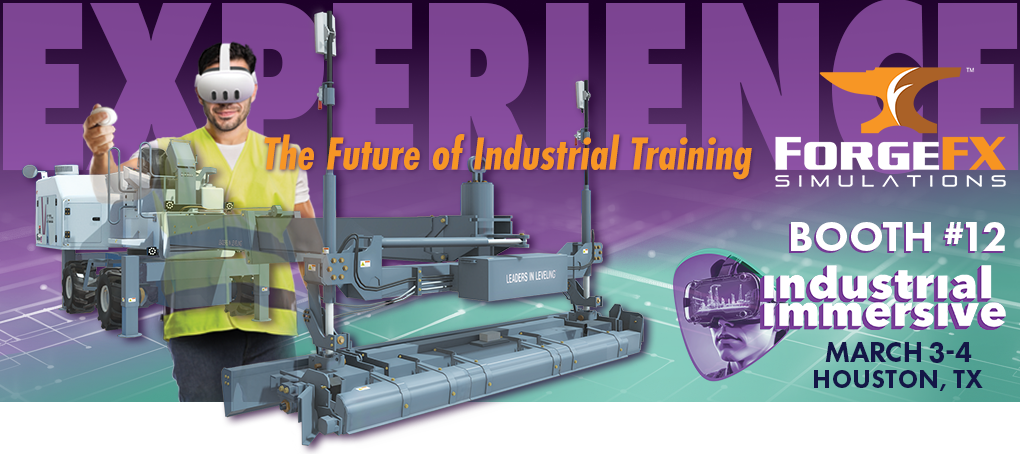
We’re excited to announce that ForgeFX Simulations will be exhibiting at Industrial Immersive 2025, bringing our latest VR-powered workforce training solutions directly to you! Join us at Booth 12 on March 3-4 in Houston, TX, for an exclusive hands-on experience with our cutting-edge industrial training simulators.

Why Visit ForgeFX at Industrial Immersive 2025?

🔧 Interactive Demonstrations: Experience firsthand how our immersive simulations transform workforce training, making it safer, smarter, and faster across multiple industries.

🎯 Industry-Specific Solutions: Whether you're in manufacturing, construction, energy, or logistics, discover how our realistic XR training environments can enhance operational efficiency and safety.

📈 Proven Impact: Learn how Fortune 500 companies are leveraging AR, VR, and XR simulations to revolutionize workforce development and reduce operational risks.

💡 Expert Insights: Connect with the ForgeFX team to discuss the latest trends in simulation-based training, AI-driven learning, and spatial computing—and how these innovations can benefit your organization.


What You’ll See at Booth 12

At ForgeFX Simulations, we specialize in developing customized simulation-based training solutions that replicate real-world equipment, environments, and workflows. Our technology enables trainees to practice complex tasks in a risk-free, highly realistic setting, leading to better retention, improved performance, and enhanced workplace safety.

Here’s what you can expect: 

Live VR Training Demonstrations – Get hands-on with our latest immersive simulations. 

Real-World Case Studies – See how global leaders are implementing XR training solutions. 

One-on-One Consultations – Learn how to integrate simulation-based training into your workforce development strategy.

Join the Industrial Training Revolution

Industrial Immersive 2025 is the must-attend event for professionals looking to leverage XR, AI, and simulation technology to improve industrial training and workforce development. Don’t miss this opportunity to connect with industry pioneers and explore groundbreaking advancements in digital twins, spatial computing, and immersive learning.

📍 Westin Memorial City, Houston, TX
📅 March 3-4, 2025
📌 Booth 12 – ForgeFX Simulations
🔗 Learn more about the event and register: Industrial Immersive 2025

Join us as we redefine the future of industrial training! 

Decoding XR Success: A Decade of Lessons With Fortune 500 Innovators

Industrial Immersive 2025: Houston, TX, March 3-4, Westin Memorial City

Join ForgeFX at the 7th Annual Industrial Immersive Event in Houston, TX!

We’re thrilled to announce that ForgeFX’s CEO and Co-Founder, Greg Meyers, will be taking the stage at the 7th Annual Industrial Immersive Event in Houston, TX!

Session Details:
📌 Title: "Decoding XR Success: A Decade of Lessons With Fortune 500 Innovators"
📍 Location: Westin Memorial City, Houston, TX
📅 Date: March 3, 2025
🔗 Learn more and register: Event Link

Decoding XR Success: A Decade of Lessons With Fortune 500 Innovators  Greg Meyers, CEO and Co-Founder of ForgeFX Simulations


Why You Can’t Miss This Session

Greg Meyers has spent over a decade leading the charge in AR, VR, XR, and simulation-based training solutions for some of the world’s largest industrial enterprises. His expertise in delivering scalable, impactful immersive technology solutions has made ForgeFX a trusted partner for industry-leading Fortune 500 companies.

In this must-attend session, Greg will take a deep dive into:

Key lessons learned from a decade of deploying XR solutions in high-stakes industries.
What makes immersive technology succeed (and fail) at an enterprise scale.
✅ Real-world case studies showcasing the power of simulation-based training.

Whether you’re just beginning your XR journey or looking to refine your enterprise-scale immersive solutions, this session will provide actionable insights you won’t find anywhere else.

The Future of Industrial Immersive Technology

The Industrial Immersive Event has established itself as the premier gathering for XR, AI, and simulation professionals focused on revolutionizing training, operations, and workforce development. As industries continue to adopt immersive technologies, staying ahead of the curve is crucial. This conference brings together thought leaders, technologists, and innovators from energy, manufacturing, aerospace, healthcare, and beyond.

By attending Greg’s session, you’ll gain a front-row seat to the latest advancements, challenges, and breakthroughs in extended reality and simulation-based training. ForgeFX’s expertise in immersive simulations has helped companies enhance workforce training, reduce operational risks, and improve overall efficiency—don’t miss this chance to learn how your organization can do the same.

Join the Conversation

The event runs from March 3-4, 2025, offering a packed agenda of insightful keynotes, hands-on demonstrations, and networking opportunities. Be sure to mark your calendar and attend Greg Meyers’ session to gain exclusive insights into the future of industrial XR solutions.

🔗 Reserve your spot today!

We look forward to seeing you in Houston this March! 

Monday, August 26, 2024

ForgeFX Simulations at the Leidos Supplier Innovation & Technology Symposium

ForgeFX had an amazing experience at the Leidos Supplier Innovation & Technology Symposium, August 6, 2024, at the Gaylord National Convention Center. This annual event is aimed at fostering collaboration, innovation, and partnership among Leidos, its suppliers, and their customers.

ForgeFX Simulations at the Leidos Supplier Innovation & Technology Symposium

We were honored to be featured in the Emerging Technologies Exhibit Hall to showcase our cutting-edge AR/VR/XR training simulators.

ForgeFX Simulations at the Leidos Supplier Innovation & Technology Symposium

To everyone from the Leidos team, fellow suppliers, and customers who visited us and experienced our immersive simulators—thank you for welcoming ForgeFX Simulations as a new supplier, and creating a platform that highlights innovation and collaboration! Your enthusiasm and engagement made this event unforgettable.

ForgeFX Simulations at the Leidos Supplier Innovation & Technology Symposium

We're looking forward to keeping the conversations going and to seeing everyone again at next year's event! 

ForgeFX Simulations at the Leidos Supplier Innovation & Technology Symposium


Friday, March 22, 2024

Comparison of Spatial Visualization Techniques for Radiation in Augmented Reality

The Luxembourg Institute of Science and Technology has published a research paper titled "Comparison of Spatial Visualization Techniques for Radiation in Augmented Reality." 

This comprehensive research paper includes a number of programs currently being used in the space, including the mixed reality interactive digital twin application that ForgeFX is working on with the JPEO for Chemical, Biological, Radiological and Nuclear Defense and the U.S. Department of Defense (DoD)


Thursday, February 29, 2024

Industrial IMMERSIVE Week

ForgeFX is excited to announce that we'll be exhibiting at Industrial IMMERSIVE Week, taking place from March 5-7, 2024, in Houston, Texas. This event stands as a pivotal gathering for professionals across the Industrial, Energy, and Engineering sectors, offering a unique platform for insights, networking, and exploration of the latest technological advancements shaping our industries.

Industrial Immersive Week 2024, ForgeFX Simulations
Industrial IMMERSIVE Week, March 5-7 Houston, Texas

During the event, ForgeFX, in collaboration with Meta at booth 34, will be demonstrating an immersive training simulator running on the Meta Quest platform. Attendees will have the opportunity to experience firsthand our leading-edge industrial training simulator powered by Meta technology. This demonstration highlights our dedication to advancing training methods through immersive learning experiences, showcasing how virtual technology can revolutionize skills development and operational efficiency.

We are excited to be part of a space where the industrial metaverse comes to life and to share how immersive technology can be a game-changer for training within our sectors. For those attending the Industrial IMMERSIVE Week, we look forward to your visit at Booth Number 34 to discover the potential of immersive training solutions together.