Showing posts with label simulation-based training. Show all posts

Thursday, May 28, 2026

Beyond VR: How Spatial Computing Turns Tribal Knowledge Into Digital Workforce Intelligence

Why industrial training simulators are becoming safer, smarter, and more scalable ways to prepare workers for complex equipment, hazardous environments, and mission-critical procedures.

Spatial Computing Simulation-Based Training: Beyond VR
Beyond VR: How Spatial Computing Training Turns Tribal Knowledge into Digital Workforce Intelligence

Industrial training is facing a new kind of pressure.

Experienced operators are retiring. Younger workers are entering the field with different expectations for how they learn. Equipment is becoming more complex. Safety expectations are increasing. And many organizations are being asked to do more with fewer highly experienced people available to train the next generation.

This is not just a staffing issue. It is a knowledge-transfer issue.

For decades, many industrial organizations have relied on a combination of classroom instruction, manuals, shadowing, and on-the-job learning. Those methods still matter, but they are not always enough for today’s equipment, procedures, and workforce challenges. A new operator may need to understand machine controls, jobsite awareness, equipment inspection, emergency procedures, team coordination, and the consequences of small mistakes — often before they have meaningful access to the real equipment.

That is where spatial computing-based simulation training becomes valuable.

Spatial computing is often associated with VR headsets, AR glasses, and mixed-reality devices. But the real value is not the headset. The real value is the ability to turn physical equipment, operational procedures, jobsite environments, safety risks, and expert decision-making into interactive 3D training systems.

For industrial organizations, this means workers can practice before they perform. They can make mistakes without damaging equipment, interrupting operations, or putting themselves and others at risk. They can repeat difficult procedures until they build confidence. And trainers can measure not just whether someone completed a course, but how they actually performed.

Spatial Computing Simulation-Based Training: Lower Costs and Less Downtime
Lower Costs and Less Downtime

That shift, from passive instruction to measurable practice, is why spatial computing is becoming an important tool for workforce development.

The workforce problem is also a training problem

The U.S. manufacturing sector alone may need as many as 3.8 million workers between 2024 and 2033, with roughly 1.9 million of those roles at risk of going unfilled if workforce challenges are not addressed, according to reporting on research from Deloitte and The Manufacturing Institute. The same reporting notes that digital skills, including simulation software skills, are becoming increasingly important in manufacturing environments.

That matters because the skills gap is not only about finding people. It is about preparing people.

Industrial work often depends on expertise that is difficult to capture in a manual. Experienced operators know what a machine should sound like. They know where not to stand. They know which steps are easy to overlook, which shortcuts are dangerous, and which abnormal conditions require immediate attention. Much of that knowledge is learned through years of experience.

The challenge is that organizations cannot always wait years for new workers to develop that judgment.

Simulation-based training helps close that gap by turning expert knowledge into structured, repeatable training experiences. A simulator can recreate the machine, the controls, the surrounding environment, the required sequence of actions, the common mistakes, and the consequences of those mistakes. Instead of relying entirely on one-on-one instruction from senior personnel, companies can preserve and scale that expertise across locations, teams, and generations of workers.

Spatial Computing Simulation-Based Training: Faster Workforce Onboarding
Faster Workforce Onboarding

Beyond “VR”: the simulator is the training system

It is tempting to think of spatial computing training as simply “putting someone in VR.” But that misses the point.

The headset, display, desktop interface, touchscreen, HoloLens, or physical controls are only the delivery mechanism. The real intelligence is in the simulation model underneath.

A strong industrial training simulator can include:

  • Accurate 3D equipment models
  • Realistic control behavior
  • Physics-based machine movement
  • Guided procedures
  • Fault conditions and emergency scenarios
  • Performance tracking
  • Instructor tools
  • Team-based multiplayer training
  • Scoring and assessment
  • Scenario variation
  • Integration with physical controls or hardware mockups

This is where spatial computing becomes more than an immersive visualization. It becomes a digital training environment.

A trainee does not just look at a machine. They operate it. They inspect it. They respond to problems. They experience the results of their decisions. And over time, the simulator can produce data that helps trainers understand where individuals or teams need more practice.

Recent industrial VR safety-training research supports this direction. A 2024 study of VR-based safety training for refinery hazards described VR as a way to provide risk-free immersive practice for emergency protocols, equipment handling, spatial navigation, and evacuation procedures in high-risk industrial settings.

That is the key idea: simulation creates a safe place to practice unsafe, expensive, rare, or difficult-to-reproduce scenarios.

What this looks like in real industrial training

ForgeFX has seen this pattern across a wide range of simulation projects: the most valuable training applications are not generic 3D experiences. They are purpose-built systems designed around specific equipment, specific learners, and specific operational goals.

For example, the JLG AccessReady Fusion XR simulator demonstrates how spatial computing can help train operators on construction equipment such as aerial work platforms and telehandlers. These machines are expensive, physically large, and often used in environments where operator awareness is essential. A simulator gives trainees an opportunity to become familiar with controls, movement, positioning, and safe operation before stepping into the real equipment.

The Somero S22EZ Laser Screed VR Training Simulator shows a similar benefit in concrete construction. Laser screed operation requires an understanding of the machine, the surface being placed, control inputs, and the workflow of the job. In a real-world setting, training time can be limited by equipment availability, job schedules, material cost, and the risk of mistakes. A VR simulator allows operators to practice the procedure in a focused environment where repetition is possible.

The Global Ground Support Aircraft Deicing Simulator shows how simulation training can support aviation ground operations. Deicing requires operators to work around aircraft, equipment, weather constraints, fluid application procedures, holdover time considerations, and team coordination. A simulator can recreate aircraft types, deicing vehicles, environmental conditions, and multi-user scenarios in a transportable format.

And in heavy equipment projects for OEMs such as John Deere, Komatsu, and Caterpillar, simulation helps manufacturers train operators, technicians, dealers, customers, and sales teams on equipment that may be expensive, difficult to transport, or not yet widely available in the field.

Different industries. Different equipment. Same underlying value: spatial computing makes complex work easier to teach, safer to practice, and easier to measure.

The safety benefit: practice the dangerous moments before they happen

No simulator should be treated as a magic solution for safety or compliance. Safety outcomes depend on culture, supervision, procedures, engineering controls, maintenance, and many other factors.

But simulation can play an important role in safety training because it allows organizations to train for moments that are difficult to practice in real life.

Spatial Computing Simulation-Based Training: Safer Training
Safer Training for High-Risk Tasks

A worker can practice responding to an equipment fault. An operator can learn what happens when a load is positioned incorrectly. A team can rehearse communication during a time-sensitive procedure. A trainee can experience a hazardous scenario without real-world consequences.

This matters because many industrial mistakes happen not because people lack information, but because they lack experience applying that information under realistic conditions.

Traditional training can explain what to do. Simulation lets people practice doing it.

That distinction is especially important for younger workers and new hires. Many digital-native learners are accustomed to interactive environments where they can experiment, receive feedback, and repeat tasks until they improve. Spatial computing-based simulation training aligns well with that learning style while still supporting the rigorous procedural standards required in industrial environments.

The operational benefit: train without disrupting the operation

Industrial training often competes with production.

Real equipment may be in use. A jobsite may not be available. A machine may be too expensive to dedicate to training. A physical training setup may require travel, instructors, fuel, materials, consumables, or downtime. Some scenarios may be too dangerous or rare to recreate safely.

Simulation helps reduce those constraints.

A simulator can be deployed in a training center, at a trade show, on a desktop, in a VR headset, in a transportable hardware station, or across multiple locations. Trainees can practice repeatedly without putting hours on machines, consuming materials, or waiting for ideal field conditions.

For OEMs, this creates an additional advantage. A training simulator can become part of the customer experience. It can help dealers demonstrate equipment. It can help customers understand safe operation. It can support onboarding for new machine models. It can reduce the burden on field trainers and make training more consistent across regions.

That is why more OEMs are viewing simulators not just as internal training tools, but as competitive advantages. A well-designed simulator can help a customer get value from equipment faster.

The measurement benefit: training becomes data

One of the most important advantages of simulation-based training is that it can produce measurable performance data. In a classroom, completion is often measured by attendance or a quiz. In a simulator, completion can be measured by actual behavior.

Spatial Computing Simulation-Based Training: Measurable Performance Data
Measurable Performance Data
Did the trainee follow the correct sequence? Did they look in the right direction before moving? Did they choose the right tool? Did they respond correctly to a fault? Did they communicate with the team? Did they complete the task efficiently? Did they repeat the same mistake across multiple attempts?

This is where simulation turns training into digital workforce intelligence.

When training systems capture performance data, organizations can identify skill gaps, improve curriculum, compare scenarios, support certification programs, and tailor coaching to the individual. Over time, this data can help companies understand not only who has been trained, but who is ready.

That distinction matters in high-consequence industries.

From tribal knowledge to scalable expertise

Every industrial organization has experts whose knowledge is hard to replace. They know the equipment. They know the job. They know the mistakes people make. They know the warning signs that do not always appear in a manual.

Spatial computing-based simulation training gives companies a way to preserve that knowledge and scale it.

Spatial Computing Simulation-Based Training: Capture Tribal Knowledge
Capture Tribal Knowledge

The process often begins by working with subject matter experts to capture procedures, decision points, equipment behavior, environmental constraints, and common failure modes. That knowledge is then transformed into interactive scenarios. The result is not just a digital replica of a machine. It is a training system built around the way work actually gets done.

This is especially valuable when organizations need to train across multiple sites, support new product launches, standardize procedures, or reduce dependence on a small number of senior trainers.

A simulator does not replace experienced instructors. It amplifies them.

It gives instructors better tools. It gives trainees more practice. And it gives organizations a more consistent way to transfer knowledge.
Spatial Computing Simulation-Based Training: Standardized Training at Scale
Standardized Training at Scale

The future: multiplayer, AI, and digital twins

The next generation of simulation training will become even more intelligent.

Spatial Computing Simulation-Based Training: Stronger Workforce. Safer Operations. Better Results.


Multiplayer training allows teams to practice coordination, communication, and role-specific responsibilities in shared virtual environments. This is particularly valuable for aviation ground support, defense, oil and gas, construction, emergency response, manufacturing, and other industries where performance depends on more than one person.

AI will support adaptive instruction, automated coaching, scenario generation, and performance analysis. Instead of every trainee receiving the same experience, training systems will be able to adjust based on what the learner does well and where they struggle.

Digital twins will make training environments more connected to real equipment, real procedures, and real operational data. As equipment becomes more instrumented and connected, training simulators can increasingly reflect how machines behave in the field.

Wednesday, February 25, 2026

ForgeFX Simulations to Showcase VR-Based Operator Training at CONEXPO-CON/AGG 2026

CONEXPO-CON/AGG 2026 is almost here, and ForgeFX Simulations is bringing the future of heavy equipment operator training to Las Vegas.

As the construction and heavy equipment industries continue to face increasing demands for safety, productivity, and workforce readiness, immersive simulation has emerged as a practical, scalable solution. At this year’s show, ForgeFX will demonstrate how VR-based operator training is moving beyond innovation headlines and delivering measurable operational impact.

Visit ForgeFX in North Hall, Booth 10330

ForgeFX Simulations will be exhibiting in North Hall, Booth 10330, where attendees can experience firsthand our latest VR-based operator training simulators built specifically for PICO XR devices.

We’re pleased to be joined in our booth by representatives from PICO XR, demonstrating how tightly integrated hardware and training software create high-performance, enterprise-ready solutions.

Our immersive training systems are designed to help operators develop real-world skills in a safe, controlled environment, as well as reduce risk and improve safety outcomes. ForgeFX Simulations helps our customers accelerate their operators' time-to-competency, increase confidence before operating live equipment, and support workforce development initiatives at scale

By replicating real equipment behavior, jobsite scenarios, and operational challenges, ForgeFX simulations allow trainees to build muscle memory and decision-making skills without exposing equipment, personnel, or production schedules to risk. For heavy equipment manufacturers and industrial organizations, this means improved readiness, reduced downtime, and stronger long-term workforce capability.

From Iron to Impact: Greg Meyers to Speak at CONEXPO

In addition to live demonstrations at the booth, ForgeFX CEO Greg Meyers will present: “From Iron to Impact”, Ground Breakers Stage, Wednesday, March 4 at 3:00 PM.

ForgeFX Simulations at CONEXPO-CON/AGG 2026, North Hall Booth N10330
ForgeFX Simulations at CONEXPO-CON/AGG 2026 — VR operator training simulators built for PICO XR, Booth N10330.

This session will explore how immersive simulation is transforming operator training across the heavy equipment sector.

Drawing on years of collaboration with leading OEMs and equipment manufacturers, Greg will share practical insights on:

  • How simulation has evolved from experimental technology to operational strategy

  • Lessons learned from implementing immersive training programs at scale

  • The measurable safety and performance outcomes manufacturers are seeing

  • Why workforce development now requires immersive, repeatable, data-driven training

The presentation reflects decades of experience working alongside industry leaders to modernize training approaches while preserving operational excellence.

Transforming Operator Training for a Changing Industry

The heavy equipment industry is undergoing significant change. Workforce shortages, increased safety expectations, and rising equipment complexity demand smarter training solutions.

Traditional methods alone are no longer sufficient to prepare operators for modern jobsite realities.

Immersive VR-based training provides a powerful complement to hands-on experience. It enables repetition without risk, performance tracking without downtime, and scalable deployment across multiple locations.

At ForgeFX Simulations, we’ve spent more than 20 years developing advanced training simulators that bridge the gap between equipment engineering and human performance. Our work at the intersection of simulation, virtual reality, and industrial training continues to push operator development forward.

CONEXPO 2026 provides an opportunity to experience that evolution firsthand.

Join Us in Las Vegas

If you’re attending CONEXPO-CON/AGG 2026, we invite you to:

  • Visit North Hall, Booth 10330 to experience our VR-based operator training built for PICO XR

  • Attend Greg Meyers’ session, “From Iron to Impact,” on Wednesday at 3:00 PM

  • Connect with our team to discuss how immersive simulation can support your training objectives

We look forward to the conversations, demonstrations, and insights that will shape the next generation of heavy equipment operator training.

See you in Las Vegas.

Friday, June 06, 2025

Built to Scale: Deploying XR Across Industrial Enterprise

We’re proud to share that ForgeFX Simulations CEO and Co-Founder, Greg Meyers, will be speaking at this year’s Augmented World Expo in Long Beach, CA—recognized as an Enterprise Expert in the field of immersive industrial training.

Built to Scale: Deploying XR Across Industrial Enterprise: Delivering practical, hard-won lessons on what it takes to build durable, adaptable training platforms that leverage XR technologies to accelerate learning, reduce costs and remove risks from industrial-scale business worldwide.

Greg Meyers, ForgeFX Simulations, Augmented World Expo USA, 2025

What does it take to move from pilot projects to enterprise-scale deployment of XR training? In this session, ForgeFX Simulations CEO Greg Meyers draws on more than a decade of experience building industrial-grade simulators for global heavy equipment leaders like Caterpillar, Vermeer, and Komatsu to offer a playbook for scaling success.

Attendees of Built to Scale: Deploying XR Across Industrial Enterprise will gain real-world insights into the barriers large organizations face—such as workforce variability, equipment risk, and the challenge of standardizing training across distributed teams—and how simulation-based XR training platforms are addressing these issues at scale. From hardware integration with OEM systems to global deployments of XR applications, this talk delivers practical, hard-won lessons on what it takes to build durable, adaptable training platforms that serve diverse operators, reduce risk, and accelerate learning across job sites worldwide. Built on the Unity platform, these solutions benefit from robust XR development tools, performance optimization


Monday, May 13, 2024

We've Been Nominated for the 2024 Auggie Awards

ForgeFX Simulations and Somero Enterprises are honored to have been nominated for the 2024 Auggie Awards in the "Best Education & Training Solution" category, for the Somero S-22EZ Laser Screed Machine Virtual Trainer.

ForgeFX Simulations and Somero Enterprises Nominated for the 2024 Auggie Awards


Public voting is now open!

https://auggies.awexr.com/entry/vote/xlmGGJJJ/jmXbkVnr

The winners will be announced at this year's Augmented World Expo, starting on June 19, in Long Beach, California. #AuggieAwards #awe #awe2024 #somero #forgefx #vrtraining #simulationtraining #VR #XR #mixedreality #XRTraining #MixedrealityTraining #metaverse #ConcreteScreed #laserscreed

Thursday, May 09, 2024

Global VR Deicing Simulator

ForgeFX Simulations is proud to partner with Global Ground Support to develop their Global VR Deicer Simulator, developed for the Meta Quest platform, the immersive training simulator puts operators on-board one of three models of a high performing Global deicer trucks. Featuring a real-time physics-based weather and precipitation fluid dynamics engine, designed to prepare operators for the exact atmospheric conditions they'll encounter on the job, the deicing simulator empowers operators to master real-world challenges.

Global VR Deicing Simulator by ForgeFX Simulations

https://globalgroundsupport.com/simulator/

Wednesday, March 13, 2024

ForgeFX Simulations at Industrial IMMERSIVE Week with Meta

Thank you to everyone who stopped by and visited ForgeFX Simulations at Industrial IMMERSIVE in Houston last week! Industrial IMMERSIVE is an initiative focused on transforming the Industrial, Energy, and Engineering sectors through the use of immersive technology.

ForgeFX Simulations at Industrial IMMERSIVE Week 2024


We had a great time exhibiting with Meta, demonstrating the mixed reality training simulator that ForgeFX Simulations built for JLG Industries, and discussing the significant business advantages of Meta for Work and Meta for Business!

Thursday, February 29, 2024

Industrial IMMERSIVE Week

ForgeFX is excited to announce that we'll be exhibiting at Industrial IMMERSIVE Week, taking place from March 5-7, 2024, in Houston, Texas. This event stands as a pivotal gathering for professionals across the Industrial, Energy, and Engineering sectors, offering a unique platform for insights, networking, and exploration of the latest technological advancements shaping our industries.

Industrial Immersive Week 2024, ForgeFX Simulations
Industrial IMMERSIVE Week, March 5-7 Houston, Texas

During the event, ForgeFX, in collaboration with Meta at booth 34, will be demonstrating an immersive training simulator running on the Meta Quest platform. Attendees will have the opportunity to experience firsthand our leading-edge industrial training simulator powered by Meta technology. This demonstration highlights our dedication to advancing training methods through immersive learning experiences, showcasing how virtual technology can revolutionize skills development and operational efficiency.

We are excited to be part of a space where the industrial metaverse comes to life and to share how immersive technology can be a game-changer for training within our sectors. For those attending the Industrial IMMERSIVE Week, we look forward to your visit at Booth Number 34 to discover the potential of immersive training solutions together.

Friday, February 23, 2024

Laser Screed® Machine Training Simulator

ForgeFX Simulations is honored to be a simulator developer for Somero Enterprises, Inc., a company that specializes in the development, manufacturing, and distribution of concrete leveling equipment and technology for the construction industry. Their product range includes laser-guided and technologically advanced machinery designed to significantly improve the efficiency, precision, and quality of concrete flooring and surface finishing. ForgeFX Simulations works with Somero® to build a laser screed machine training simulator that empowers operators to conduct safe and cost-effective virtual training. A Laser Screed® machine is a specialized piece of equipment used in the construction industry for leveling large areas of concrete with high precision, that employs laser technology as a reference to control the position of the leveling head accurately during the concrete pouring process.

Somero Enterprises Laser Screed® Meta Quest Simulator by ForgeFX Simulations

Somero is passionate about the success of their customers, which is why they have created the Somero Concrete Institute, a comprehensive training facility dedicated to providing education on Somero’s products and offering unparalleled education and support. The S-22 EZ Laser Screed Training Simulator, developed by ForgeFX Simulations, will be the latest training experience to be offered by Somero, as they strive to deliver unparalleled learning opportunities through a mix of theoretical knowledge and practical, hands-on training.

S-22EZ Advanced Laser Screed® Machine Simulator

ForgeFX Simulations works closely with Somero subject matter experts to develop their S-22EZ Advanced Laser Screed® Machine Simulator training program. This highly realistic, interactive, and engaging training simulation application significantly enhances the learning of operators by immersing them in a fully virtual environment that contains a detailed and accurate digital 3D replica of the S-22 Laser Screed® Machine. Taking advantage of Meta’s Quest mixed reality hardware, the simulator delivers users simulated physical controls, buttons, and feedback mechanisms that afford the ability to rapidly become familiar with the machine, learn and master the controls and maintenance techniques, and comprehend the fundamentals of using the equipment properly and effectively. Utilizing Meta Quest’s superior hand-tracking capabilities provides for a more fully immersive experience, where users have a greater sense of presence and agency.

Learn more: https://forgefx.com/simulation-projects/laser-screed-machine-training-simulator/


Tuesday, September 19, 2023

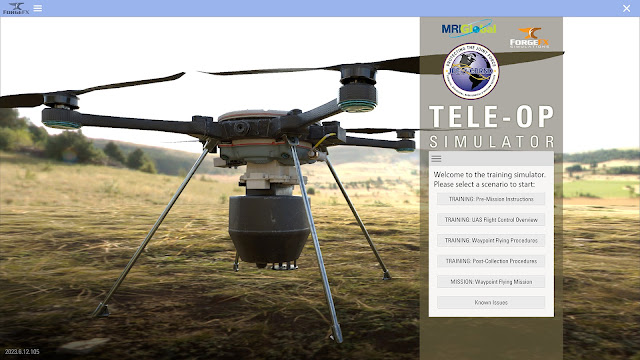
Unmanned Aircraft System (UAS) Training Simulator Delivered to JPEO-CBRND by ForgeFX Simulations and MRIGlobal

UAS simulator gives JPEO-CBRND the ability to deploy simulation-based training to operators to master the controls and process involved in operating a UAV.
ForgeFX Simulations Delivers UAS Training Simulator to JPEO-CBRND
This interactive 3D virtual training simulator is designed to instruct CBRND personnel in the remote operation of an Unmanned Aircraft System (UAS) from within a Nuclear Biological Chemical Reconnaissance Vehicle (NBCRV). Working directly with subject matter experts (SMEs) from the DoD and Teledyne FLIR, ForgeFX created digital replicas of their physical and virtual products, reproducing all the functions the physical objects perform. This simulator, running on a standard tablet computer, gives the JPEO-CBRND the ability to widely deploy simulation-based training to operators, who can master the complex controls and processes involved in operating a UAV and all of the onboard sensors it carries. 

 The simulator recreates a CBRND reconnaissance mission featuring an NBCRV equipped with a sensor suite array and two pods, each containing a UAS. The UAS in the simulator is an R80D Skyraider drone carrying a MUVETM B330 Continuous Biological Detector and Collector payload, both manufactured by Teledyne FLIR. The Skyraider is launched from the NBCRV and directed into an area suspected to be contaminated by airborne substances. Operated by means of the ATAK application running on a tablet computer inside the NBCRV, the drone’s sensor payload helps the CBRND personnel triangulate on the position, speed, and contents of airborne contamination. 

Tuesday, July 11, 2023

MRIGlobal and ForgeFX Simulations Partner to Advance CBRN Special Operations Simulator

The Joint Program Executive Office for Chemical, Biological, Radiological and Nuclear Defense (JPEO-CBRND) has selected MRIGlobal and ForgeFX Simulations to bring the latest advances in simulation-based training programs to its Nuclear Biological Chemical Reconnaissance Vehicle (NBCRV) technology and deployment strategies. As the military continues to modernize and upgrade its hardware and software capabilities, its training must keep pace to ensure warfighters remain at the top of their game. The newest installment to these programs will update the JPEO-CBRND’s Tele Operations Simulator for the modern UAS (Unmanned Aerial Systems) used by the military today. First produced in 2020, the Tele-Op Simulator is among a series of simulation-based training and visualization products that MRIGlobal and ForgeFX Simulations have collaborated on for the US Government. The original simulator includes a virtual Polaris MRZR equipped as an unmanned ground vehicle (UGV). Mounted with previous prototype Chemical, Biological, Radiological, and Nuclear (CBRN) detection equipment and activated with onboard controls, the UGV is piloted via a customized version of the ATAK (Android Team Awareness Kit) application. Using a module that recreates the ATAK interface, the simulator allows trainees to activate and remotely drive the virtual UGV across several square kilometers of virtual terrain, exactly as they would in the field. Read the full press release here: MRIGlobal and ForgeFX Simulations Partner to Advance CBRN Special Operations Simulator

Monday, December 12, 2022

CBRND HoloTrainer at 2022 Chemical and Biological Defense Science &Technology (CBD S&T) Conference

The CBRND HoloTrainer is an augmented reality device training simulator built for the Microsoft HoloLens 2 by ForgeFX Simulations and MRIGlobal. The CBRND HoloTrainer instructs trainees in the familiarization, operation, and maintenance of chemical, biological, radiological and nuclear detection devices by providing holographically-projected interactive 3D virtual versions of the devices for trainees to train on.
Peter Anderson, Principal Engineer at MRIGlobal, demonstrates the CBRND HoloTrainer, a suite of augmented reality device training simulators developed by MRIGlobal and ForgeFX Simulations, at the 2022 Chemical and Biological Defense Science and Technology Conference in San Francisco, California. https://forgefx.com/simulation-projects/augmented-reality-device-training-simulators/

Monday, August 01, 2022

Thursday, January 27, 2022

First of Its Kind Virtual Reality Training Aims to Help Growing Demand in Skilled Trade Jobs Amid New Infrastructure Bill

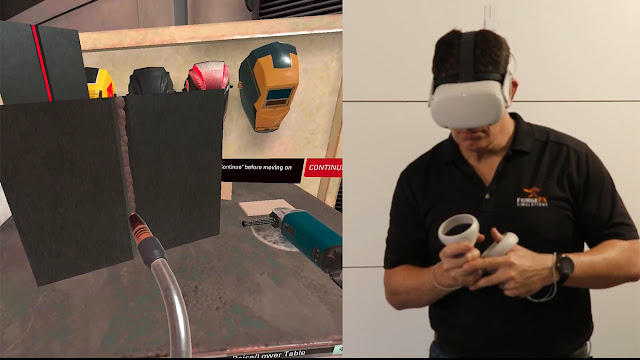
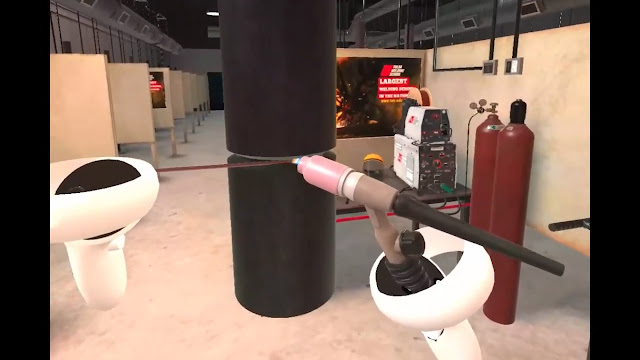
ForgeFX Simulations is proud to be a training simulator development partner of StrataTech Education Group, a company that focuses on the acquisition, growth and development of specialized career education schools, particularly skilled-trade programs designed to address the nation’s growing infrastructure needs. ForgeFX worked with StrataTech and their subsidiary, the Tulsa Welding School, to develop OcuWeld™, a virtual reality welding training simulator program that teaches students how to prep, grind and join materials in a virtual environment that removes the safety and cost concerns.

ForgeFX Simulations - Welding Training Simulator

OcuWeld Welding Training Simulator

Welcome to the digital transformation of education! The OcuWeld™ welding training simulator utilizes virtual reality to enhance welding training programs using the Meta Quest VR device. Designed by welders for welders, and developed by seasoned ForgeFX Simulations developers, OcuWeld provides welding students with the opportunity to practice their hands-on training in a virtual environment where concerns about safety, access and cost are no longer relevant. OcuWeld immerses students in a virtual environment that mimics real life training experiences and provides the opportunity to practice skills independently.


StrataTech has integrated OcuWeld into the curricula of their subsidiaries, Tulsa Welding School and The Refrigeration School, to ensure that students have future-proof skills that employers are seeking. The program launches at a time when demand for skilled trade workers is at an all-time high in part due to the recently passed Infrastructure Bill. The bill, combined with President Biden’s Build Back Framework, will add an average of 1.5 million jobs per year for the next 10 years, according to The White House.

OcuWeld - Virtual Reality Welding Training Simulator

First of Its Kind Virtual Reality Training Aims to Help Growing Demand in Skilled Trade Jobs Amid New Infrastructure Bill

The growing pace of digitization is shifting the paradigm of education to lifelong learning that requires a continual evolution of technical skills and training. Alex DeClair and Chris Schuler, directors of the welding programs at The Refrigeration School, Inc. (RSI) and Tulsa Welding School (TWS), say today’s students have different needs, and infusing technology into programs is now imperative in the modern education space. Similarly, Chase Lane, VP of Transformation for StrataTech, understands the need for digital transformation in education and its role in addressing the nation’s critical infrastructure needs.

“It’s time that higher education meets the needs of its students rather than vice versa,” said Lane. “Digital is transforming education and ensuring that these technological advances reach the skilled trades is extremely important to StrataTech and vital to the growing needs of our labor force.”

OcuWeld engages students with a mixture of gamification and education. Students enjoy learning in a fun and highly interactive and dynamic environment that mimics real-world applications.

“As educators, it is our responsibility to ensure that we infuse technology into our programs and curriculum to meet the changing needs of our students and their future employers,” said Mary Kelly, President/CEO of StrataTech. “OcuWeld will not only help our students get additional training, it will also position them to meet the growing demand for skilled professionals.”

Read the full OcuWeld Business Wire press release.


#virtualreality #training #simulator

Tuesday, May 18, 2021

MRIGlobal Award From The Joint Project Lead For Chemical, Biological, Radiological, And Nuclear Special Operations Forces Expands Use Of Augmented Reality Technology For Defense Training

 KANSAS CITY, Mo., May 18, 2021 /PRNewswire/ -- MRIGlobal was awarded a program by The Joint Project Lead for Chemical, Biological, Radiological, and Nuclear Special Operations Forces (JPL CBRN SOF) to expand and extend the use of augmented reality technology to provide flexible, anytime/anywhere device familiarization, operations, and maintenance training for the warfighter.

In a continuing partnership with ForgeFX Simulations, a team of engineers will design, develop, and deliver Microsoft HoloLens training applications for a series of field-deployed CBRN sensors. The warfighter will then be able to experience flexible, self-directed, multi-user, and remote device training with or without (i.e. virtual hologram) access to the CBRN sensors.

https://apnews.com/press-release/pr-newswire/business-technology-6f1fee39bb50bc216fcc683220dc9320

“Our efforts with ForgeFX Simulations to design, develop and deliver Microsoft HoloLens training modules is a great example of how recent technological advancements are accelerating the development of novel applications and capabilities for use in training the next generation warfighter,” said Dean Gray, Ph.D., Vice President of Defense, MRIGlobal. “Ultimately this training supports our soldiers to more efficiently and proficiently prepare for their operational missions.”

About MRIGlobal

MRIGlobal addresses some of the world’s greatest threats and challenges. Founded in 1944 as an independent, non-profit organization, we perform contract research for government, industry, and academia. Our customized solutions in national security and defense and health include research and development capabilities in clinical research support, infectious disease and biological threat agent detection, global biological engagement, in vitro diagnostics, and laboratory management and operations. MRIGlobal is one of two partners in the Alliance for Sustainable Energy, LLC, which manages and operates the National Renewable Energy Laboratory (NREL) in Golden, Colorado, for the U.S. Department of Energy. For more information, visit mriglobal.org

About ForgeFX Simulations

ForgeFX is a training simulation software development company. Founded in 2002, ForgeFX develops high-quality custom interactive 3D simulation and visualization software products for clients across a wide array of industries. Leveraging high-fidelity 3D graphics and game engine development tools, ForgeFX provides virtual and augmented reality application development services for clients who are looking to distribute interactive simulation-based training solutions. Our training products—employed by industries including national defense, healthcare, pharmaceutical, insurance, mining, construction, and transportation—produce measurable improvements in trainee engagement and knowledge retention. For more information, visit forgefx.com


Monday, January 08, 2018

ForgeFX Simulations at World of Concrete 2018


ForgeFX Simulations is excited to be exhibiting at World of Concrete this year, January 22-26, 2018, at the Las Vegas Convention Center. World of Concrete is the largest annual international event dedicated to concrete and masonry professionals. Boasting more than 50,000 attendees and 1,500 exhibiting companies, World of Concrete showcases products, technology, resources, and information related to concrete construction.

ForgeFX is proud to be exhibiting at World of Concrete this year, demonstrating our industrial equipment training simulators and how they can be leveraged by the concrete and masonry industry. This year, one of the simulators we'll be demonstrating is the VR Equipment Training Simulator that ForgeFX Simulations developed for JLG Industries.


Be sure to stop by booth #C7629 to meet the ForgeFX team, and try your hand at operating one of our virtual training simulators. Simulators are ideal tools for training heavy equipment operators to operate sophisticated concrete machinery. They are cost-effective, safe, and efficient methods for training all concepts and skills from controls familiarization to procedure compliance.


If you'll be attending World of Concrete this year, please contact ForgeFX Simulations to schedule an appointment to operate one of our virtual reality training simulators, or just stop by booth #C7629. We'll see you at the show!


www.forgefx.com Contact ForgeFX Simulations Get updates by liking us on Facebook Get updates on Facebook Get tweets by following us on Twitter Get tweets on Twitter Stay connected by following us on LinkedIn Connect on LinkedIn Watch videos by subscribing to ForgeFX on YouTube Watch on YouTube


Thursday, May 11, 2017

JLG VR Training Simulator at Vision VR/AR Summit

Thank you to everyone who participated in last week's Vision VR/AR Summit in Hollywood, CAwhat a show! ForgeFX Training Simulations was honored to demonstrate the JLG Immersive Trainer, a virtual reality-based industrial equipment training simulator, that we developed for JLG Industries, Inc. JLG's VR-based equipment simulator provides training on everything from machine control familiarization, to equipment operation, to advanced spatial awareness challenges.


JLG Industries, Inc., an Oshkosh Corporation company and a leading global manufacturer of aerial work platforms and telehandlers, partnered with ForgeFX Training Simulations to develop the JLG Immersive Trainer, a virtual reality industrial training simulator for JLG equipment. The JLG Immersive Trainer was featured in the at the 2017 Unity Vision VR/AR Summit Showcase, where attendees could "meet the innovators pioneering the best in virtual, augmented, and mixed realities from around the world.".

Virtual Reality Industrial Training Simulator

Virtual reality and industrial training simulators are a marriage made in heaven. By deploying industrial equipment training simulators as VR applications, we are able to deliver a virtual training experience that is far more immersive than traditional screen-based training simulators. The JLG VR Equipment Training Simulator, in addition to featuring interactive real-time stereoscopic 3D environments and equipment types, includes head, hand and positional tracking, which gives the trainee the ability to interact with the virtual world and machinery in a dramatically lifelike and realistic fashion.

Vision VR/AR Summit, VR Industrial Training Simulator
By integrating fully functional real-world equipment controls, and corresponding in-simulation virtual controls, the JLG Immersive Trainer provides an extremely interactive and immersive virtual industrial training simulator.

Unity Vision VR/AR Summit 2017

The Vision VR/AR Summit, sponsored by Unity Technologies, is an event for artists, engineers, programmers, designers, musicians, directors, producers, hardware manufacturers and researchers. The content and networking are focused on furthering the knowledge base of anyone developing virtual and/or augmented reality content in Unity. This year's showcase featured dozens of great talks and demonstrations from some of the biggest companies and contributors that are advancing the use of virtual and augmented reality.

Vision Summit 2017 Keynotes

Unity Technologies has made a number of the Vision VR/AR Summit 2017 Keynotes available on their YouTube channel. Watch the Vision VR/AR Summit 2017 Keynote with an intro from Unity Global Head of xR Tony Parisi. In his address, Unity CEO John Riccitiello outlines how and when VR will truly take off.

John Riccitiello, CEO, Unity Technologies

Brandon Bray - Principal Group Mgr, Microsoft 

Marcus Kuehne - Strategy Lead Immersive Technologies, Audi AG

Unity Vision VR/AR Summit Review, VRScout

For a great recap of the Unity Vision VR/AR Summit 2017, check out VRScout's review and their wrap video:

Vision VR/AR Summit, VR Scout Wrap Video


www.forgefx.com Contact us on ForgeFX Get updates by liking us on Facebook Get updates on Facebook Get tweets by following us on Twitter Get tweets on Twitter Stay connected by following us on LinkedIn Connect on LinkedIn Watch videos by subscribing to ForgeFX on YouTube Watch on YouTube


Friday, March 03, 2017

ForgeFX Simulations Exhibiting New VR Simulators at CONEXPO 2017

ForgeFX Simulations will be exhibiting their new Virtual Reality (VR) training simulators at CONEXPO 2017 in Las Vegas, March 7-11, Gold Hall Booth #G73420.

CONEXPO is a trade show for the construction industry that takes place every three years, showcasing the latest construction equipment, products, services and technologies. ForgeFX Simulations will be demonstrating two VR-based training simulators at CONEXPO this year, an aerial work platform operator training simulator developed for JLG Industries, and an aircraft deicing training simulator developed for Global Ground Support.

ForgeFX Simulations, Custom Virtual Training Simulations

ForgeFX's VR-based training simulators immerse trainees in a way traditional flat screen-based training simulators can't. Operators can instantly take advantage of head-tracking, which allows them to look all around in 360 degrees, just as they do in the real-world, allowing them to keep their hands on the real-world controls. 

ForgeFX Simulations - Custom VR-Based Simulations


The simulators take advantage of hand-tracking cameras, so that users are able to interact with real-world and virtual controls within the simulator, providing a true mixed reality experience.

JLG Industries, Immersive Training Simulator

The JLG Immersive Training Simulator will located at three places at CONEXPO this year. Networked multi-player VR simulators will be available at JLG Industries, Gold Lot Booth #3946 and at the Tech Experience, Silver Lot 3. ForgeFX Simulations will also be hosting a single-player version of the JLG VR equipment training simulator. If you only have time to try out one demo at CONEXPO this year, be sure to make it the JLG Immersive Training Simulator — it's sure to be a hit!
https://www.jlg.com/en/conexpo-2017/at-the-show

JLG Industries, VR Immersive Training Simulator


Global Ground Support, Aircraft Deicing Training Simulation

The Global Ground Support Aircraft Deicing Training Simulation is a networked multi-user training simulator that supports the Oculus Rift VR head-mounted display system. The simulator, which integrates real-world operator controls, takes advantage of hand-tracking technology and in-simulation virtual controls, to deliver a truly mixed-reality experience

VR Training Simulator for Aircraft Deicing

If you're planning on attending ConExpo 2017, please be sure to come by and visit ForgeFX Simulations at Gold Hall Booth #G73420. We are looking forward to demonstrating our latest VR-based training simulators and talking with attendees about the potential uses of VR and simulation-based training.


www.forgefx.com Contact us on ForgeFX Get updates by liking us on Facebook Get updates on Facebook Get tweets by following us on Twitter Get tweets on Twitter Stay connected by following us on LinkedIn Connect on LinkedIn Watch videos by subscribing to ForgeFX on YouTube Watch on YouTube


Monday, December 12, 2016

Thanks for visiting ForgeFX at I/ITSEC 2016

Thank you to everyone who stopped by the ForgeFX Simulations booth at the Interservice/Industry Training, Simulation and Education Conference (I/ITSEC) in Orlando earlier this month. We really enjoyed meeting everyone at the show, demonstrating our latest simulation-based trainers, hearing about potential uses for our services, and getting tons of invaluable feedback from the public on simulators.

ForgeFX Simulations - I/ITSEC 2016
ForgeFX demonstrating their latest VR-based training simulators at I/ITSEC 2016
This year's 50th anniversary of I/ITSEC was an blast and ForgeFX was pleased to help celebrate 50 years of innovation in modeling, simulation and training. Thanks to Janet Spruill, I/ITSEC 2016 Conference Chair, and the entire I/ITSEC staff for putting on another fantastic event.

ForgeFX Simulations was proud to be an exhibitor for the 5th year in a row, demonstrating our custom virtual reality training simulators to all of the attendees on the exhibit floor. A special thank you to all of the US Air Force ROTC Juniors who attended our simulation demonstrations and helped us beta test some of our VR-based simulators.

Air Force ROTC Juniors with ForgeFX at I/ITSEC 2016
Air Force ROTC Juniors spending time with ForgeFX Simulations at I/ITSEC 2016
VR-based industrial training simulators at I/ITSEC by ForgeFX
HTC Vive-based room scale VR training simulations

Virtual Reality (VR) Industrial Equipment Training Simulators

The VR-based aircraft deicing simulator that ForgeFX developed for Global Ground Support was a big favorite at the show. Operators were immersed in a fully interactive, virtual 360 degree snowing airport environment, where they have both head tracking and positional tracking capabilities within the virtual world, also known as 6 degrees of freedom. These 6 degrees of freedom allow operators to feel a sense of presence in the virtual world, so they focus on machine control operation as well as the complexities of the job they're training for.

ForgeFX CTO, Adam Kane, demonstrates a VR-based training simulator at I/ITSEC 2016
Coupled with hand-tracking and real-world controller integration, VR training simulators replicate real-world equipment, environments and spatial relations challenges. This combination provides a high-impact training environment. 

Innovation Showcase

ForgeFX Simulations President and Co-Founder, Greg Meyers, presented a talk at the Innovation Showcase pavilion where he discussed using modern game engine technology to produce and deploy VR-based industrial training simulators

ForgeFX VR-Based Training Simulators

ForgeFX featured 2 of their latest VR-based industrial training simulators at I/ITSEC 2016, an aircraft deicing simulator developed for Global Ground Support, and an aerial work platform training simulator developed for JLG Industries.


Thanks again to everyone who made I/ITSEC 2016 a huge success. We're looking forward to speaking with everyone whom we made contact with at this year's show. Please don't hesitate to contact ForgeFX Simulations to discuss custom training solutions for your organization, and we'll see everyone again next year at I/ITSEC 2017!


www.forgefx.com Contact us on ForgeFX Get updates by liking us on Facebook Get updates on Facebook Get tweets by following us on Twitter Get tweets on Twitter Stay connected by following us on LinkedIn Connect on LinkedIn Watch videos by subscribing to ForgeFX on YouTube Watch on YouTube