Showing posts with label training simulator. Show all posts

Thursday, May 28, 2026

Beyond VR: How Spatial Computing Turns Tribal Knowledge Into Digital Workforce Intelligence

Why industrial training simulators are becoming safer, smarter, and more scalable ways to prepare workers for complex equipment, hazardous environments, and mission-critical procedures.

Spatial Computing Simulation-Based Training: Beyond VR
Beyond VR: How Spatial Computing Training Turns Tribal Knowledge into Digital Workforce Intelligence

Industrial training is facing a new kind of pressure.

Experienced operators are retiring. Younger workers are entering the field with different expectations for how they learn. Equipment is becoming more complex. Safety expectations are increasing. And many organizations are being asked to do more with fewer highly experienced people available to train the next generation.

This is not just a staffing issue. It is a knowledge-transfer issue.

For decades, many industrial organizations have relied on a combination of classroom instruction, manuals, shadowing, and on-the-job learning. Those methods still matter, but they are not always enough for today’s equipment, procedures, and workforce challenges. A new operator may need to understand machine controls, jobsite awareness, equipment inspection, emergency procedures, team coordination, and the consequences of small mistakes — often before they have meaningful access to the real equipment.

That is where spatial computing-based simulation training becomes valuable.

Spatial computing is often associated with VR headsets, AR glasses, and mixed-reality devices. But the real value is not the headset. The real value is the ability to turn physical equipment, operational procedures, jobsite environments, safety risks, and expert decision-making into interactive 3D training systems.

For industrial organizations, this means workers can practice before they perform. They can make mistakes without damaging equipment, interrupting operations, or putting themselves and others at risk. They can repeat difficult procedures until they build confidence. And trainers can measure not just whether someone completed a course, but how they actually performed.

Spatial Computing Simulation-Based Training: Lower Costs and Less Downtime
Lower Costs and Less Downtime

That shift, from passive instruction to measurable practice, is why spatial computing is becoming an important tool for workforce development.

The workforce problem is also a training problem

The U.S. manufacturing sector alone may need as many as 3.8 million workers between 2024 and 2033, with roughly 1.9 million of those roles at risk of going unfilled if workforce challenges are not addressed, according to reporting on research from Deloitte and The Manufacturing Institute. The same reporting notes that digital skills, including simulation software skills, are becoming increasingly important in manufacturing environments.

That matters because the skills gap is not only about finding people. It is about preparing people.

Industrial work often depends on expertise that is difficult to capture in a manual. Experienced operators know what a machine should sound like. They know where not to stand. They know which steps are easy to overlook, which shortcuts are dangerous, and which abnormal conditions require immediate attention. Much of that knowledge is learned through years of experience.

The challenge is that organizations cannot always wait years for new workers to develop that judgment.

Simulation-based training helps close that gap by turning expert knowledge into structured, repeatable training experiences. A simulator can recreate the machine, the controls, the surrounding environment, the required sequence of actions, the common mistakes, and the consequences of those mistakes. Instead of relying entirely on one-on-one instruction from senior personnel, companies can preserve and scale that expertise across locations, teams, and generations of workers.

Spatial Computing Simulation-Based Training: Faster Workforce Onboarding
Faster Workforce Onboarding

Beyond “VR”: the simulator is the training system

It is tempting to think of spatial computing training as simply “putting someone in VR.” But that misses the point.

The headset, display, desktop interface, touchscreen, HoloLens, or physical controls are only the delivery mechanism. The real intelligence is in the simulation model underneath.

A strong industrial training simulator can include:

  • Accurate 3D equipment models
  • Realistic control behavior
  • Physics-based machine movement
  • Guided procedures
  • Fault conditions and emergency scenarios
  • Performance tracking
  • Instructor tools
  • Team-based multiplayer training
  • Scoring and assessment
  • Scenario variation
  • Integration with physical controls or hardware mockups

This is where spatial computing becomes more than an immersive visualization. It becomes a digital training environment.

A trainee does not just look at a machine. They operate it. They inspect it. They respond to problems. They experience the results of their decisions. And over time, the simulator can produce data that helps trainers understand where individuals or teams need more practice.

Recent industrial VR safety-training research supports this direction. A 2024 study of VR-based safety training for refinery hazards described VR as a way to provide risk-free immersive practice for emergency protocols, equipment handling, spatial navigation, and evacuation procedures in high-risk industrial settings.

That is the key idea: simulation creates a safe place to practice unsafe, expensive, rare, or difficult-to-reproduce scenarios.

What this looks like in real industrial training

ForgeFX has seen this pattern across a wide range of simulation projects: the most valuable training applications are not generic 3D experiences. They are purpose-built systems designed around specific equipment, specific learners, and specific operational goals.

For example, the JLG AccessReady Fusion XR simulator demonstrates how spatial computing can help train operators on construction equipment such as aerial work platforms and telehandlers. These machines are expensive, physically large, and often used in environments where operator awareness is essential. A simulator gives trainees an opportunity to become familiar with controls, movement, positioning, and safe operation before stepping into the real equipment.

The Somero S22EZ Laser Screed VR Training Simulator shows a similar benefit in concrete construction. Laser screed operation requires an understanding of the machine, the surface being placed, control inputs, and the workflow of the job. In a real-world setting, training time can be limited by equipment availability, job schedules, material cost, and the risk of mistakes. A VR simulator allows operators to practice the procedure in a focused environment where repetition is possible.

The Global Ground Support Aircraft Deicing Simulator shows how simulation training can support aviation ground operations. Deicing requires operators to work around aircraft, equipment, weather constraints, fluid application procedures, holdover time considerations, and team coordination. A simulator can recreate aircraft types, deicing vehicles, environmental conditions, and multi-user scenarios in a transportable format.

And in heavy equipment projects for OEMs such as John Deere, Komatsu, and Caterpillar, simulation helps manufacturers train operators, technicians, dealers, customers, and sales teams on equipment that may be expensive, difficult to transport, or not yet widely available in the field.

Different industries. Different equipment. Same underlying value: spatial computing makes complex work easier to teach, safer to practice, and easier to measure.

The safety benefit: practice the dangerous moments before they happen

No simulator should be treated as a magic solution for safety or compliance. Safety outcomes depend on culture, supervision, procedures, engineering controls, maintenance, and many other factors.

But simulation can play an important role in safety training because it allows organizations to train for moments that are difficult to practice in real life.

Spatial Computing Simulation-Based Training: Safer Training
Safer Training for High-Risk Tasks

A worker can practice responding to an equipment fault. An operator can learn what happens when a load is positioned incorrectly. A team can rehearse communication during a time-sensitive procedure. A trainee can experience a hazardous scenario without real-world consequences.

This matters because many industrial mistakes happen not because people lack information, but because they lack experience applying that information under realistic conditions.

Traditional training can explain what to do. Simulation lets people practice doing it.

That distinction is especially important for younger workers and new hires. Many digital-native learners are accustomed to interactive environments where they can experiment, receive feedback, and repeat tasks until they improve. Spatial computing-based simulation training aligns well with that learning style while still supporting the rigorous procedural standards required in industrial environments.

The operational benefit: train without disrupting the operation

Industrial training often competes with production.

Real equipment may be in use. A jobsite may not be available. A machine may be too expensive to dedicate to training. A physical training setup may require travel, instructors, fuel, materials, consumables, or downtime. Some scenarios may be too dangerous or rare to recreate safely.

Simulation helps reduce those constraints.

A simulator can be deployed in a training center, at a trade show, on a desktop, in a VR headset, in a transportable hardware station, or across multiple locations. Trainees can practice repeatedly without putting hours on machines, consuming materials, or waiting for ideal field conditions.

For OEMs, this creates an additional advantage. A training simulator can become part of the customer experience. It can help dealers demonstrate equipment. It can help customers understand safe operation. It can support onboarding for new machine models. It can reduce the burden on field trainers and make training more consistent across regions.

That is why more OEMs are viewing simulators not just as internal training tools, but as competitive advantages. A well-designed simulator can help a customer get value from equipment faster.

The measurement benefit: training becomes data

One of the most important advantages of simulation-based training is that it can produce measurable performance data. In a classroom, completion is often measured by attendance or a quiz. In a simulator, completion can be measured by actual behavior.

Spatial Computing Simulation-Based Training: Measurable Performance Data
Measurable Performance Data
Did the trainee follow the correct sequence? Did they look in the right direction before moving? Did they choose the right tool? Did they respond correctly to a fault? Did they communicate with the team? Did they complete the task efficiently? Did they repeat the same mistake across multiple attempts?

This is where simulation turns training into digital workforce intelligence.

When training systems capture performance data, organizations can identify skill gaps, improve curriculum, compare scenarios, support certification programs, and tailor coaching to the individual. Over time, this data can help companies understand not only who has been trained, but who is ready.

That distinction matters in high-consequence industries.

From tribal knowledge to scalable expertise

Every industrial organization has experts whose knowledge is hard to replace. They know the equipment. They know the job. They know the mistakes people make. They know the warning signs that do not always appear in a manual.

Spatial computing-based simulation training gives companies a way to preserve that knowledge and scale it.

Spatial Computing Simulation-Based Training: Capture Tribal Knowledge
Capture Tribal Knowledge

The process often begins by working with subject matter experts to capture procedures, decision points, equipment behavior, environmental constraints, and common failure modes. That knowledge is then transformed into interactive scenarios. The result is not just a digital replica of a machine. It is a training system built around the way work actually gets done.

This is especially valuable when organizations need to train across multiple sites, support new product launches, standardize procedures, or reduce dependence on a small number of senior trainers.

A simulator does not replace experienced instructors. It amplifies them.

It gives instructors better tools. It gives trainees more practice. And it gives organizations a more consistent way to transfer knowledge.
Spatial Computing Simulation-Based Training: Standardized Training at Scale
Standardized Training at Scale

The future: multiplayer, AI, and digital twins

The next generation of simulation training will become even more intelligent.

Spatial Computing Simulation-Based Training: Stronger Workforce. Safer Operations. Better Results.


Multiplayer training allows teams to practice coordination, communication, and role-specific responsibilities in shared virtual environments. This is particularly valuable for aviation ground support, defense, oil and gas, construction, emergency response, manufacturing, and other industries where performance depends on more than one person.

AI will support adaptive instruction, automated coaching, scenario generation, and performance analysis. Instead of every trainee receiving the same experience, training systems will be able to adjust based on what the learner does well and where they struggle.

Digital twins will make training environments more connected to real equipment, real procedures, and real operational data. As equipment becomes more instrumented and connected, training simulators can increasingly reflect how machines behave in the field.

Monday, July 07, 2025

ForgeFX Simulations’ Recap: Our Unforgettable Experience at AWE USA 2025

Long Beach, CA – June 2025: What a week! As we pack up from Augmented World Expo USA 2025, we’re still buzzing with excitement from an incredible few days of innovation, connection, and inspiration. From unveiling our new immersive booth to launching cutting-edge products, giving VIP tours, and taking the stage to share our vision, AWE USA 2025 was an event we’ll never forget—and we’re thrilled to share the highlights with you.

Stepping Into the Future: Our Immersive Booth

This year, we wanted our booth to do more than showcase our technology—we wanted it to immerse visitors in the world of ForgeFX Simulations. Designed to reflect the realism and interactivity of our training simulators, the booth became a hub for hands-on experiences.

Attendees immediately felt a sense of presence and they entered, then strapping on headsets to operate virtual heavy equipment, troubleshoot machinery with AR and VR maintenance tools, and explore enterprise training environments designed for some of the world’s largest organizations.

"Your booth is one of the most engaging experiences on the show floor!" – AWE Attendees

ForgeFX Simulations Augmented World Expo (AWE) USA 2025
ForgeFX Simulations, Augmented World Expo USA 2025

Sharing Our Vision: Greg Meyers on Stage

On Day 3 of AWE USA 2025, our CEO, Greg Meyers, took the stage to present the session “Built to Scale: Deploying XR Across Industrial Enterprise.” Greg shared ForgeFX’s perspective on how immersive technologies are helping enterprises scale training programs and operational tools across large, distributed workforces.

He discussed ForgeFX’s success deploying VR and AR simulators in high-stakes industries like energy and defense, showing how organizations can deliver realistic, repeatable, and risk-free training at scale.

“XR isn’t just a technology trend—it’s a business imperative for companies that need to train and enable workers faster, safer, and smarter,” Greg emphasized.

The session drew a crowd of professionals across a wide spectrum of disciplines, with many attendees staying afterward to ask questions and continue the conversation about how ForgeFX’s solutions could help their organizations achieve similar results.

Greg Meyers ForgeFX Simulations CEO and Co-Founder at AWE USA 2025
Greg Meyers, ForgeFX Simulations CEO and Co-Founder, AWE USA 2025

Following our immersive showcase at AWE USA 2025, we were thrilled to witness the broader XR landscape's dynamic evolution. The event was a melting pot of innovation, with several standout companies unveiling groundbreaking technologies that are shaping the future of immersive experiences.

XR Industry Highlights at AWE USA 2025

PICO presented the PICO 4 Ultra Enterprise, an all-in-one mixed reality headset tailored for enterprise applications. Equipped with advanced MR capabilities and the PICOMotion Tracker for comprehensive body and object tracking, PICO's solution aims to deliver highly immersive and practical experiences across industries. Their booth offered hands-on demonstrations, highlighting applications in education, training, and location-based entertainment.

Swiss company CREAL captivated attendees with its latest Clarity light-field display. This technology offers a more natural and comfortable visual experience by mimicking how our eyes perceive depth in the real world. Visitors experienced this through both a headset and a tabletop pair of glasses, showcasing the versatility of CREAL's approach to immersive displays.

XREAL (formerly Nreal) showcased its One Series AR glasses, emphasizing spatial computing capabilities. They also introduced the XREAL EYE, a modular camera attachment enhancing the functionality of their AR glasses. Additionally, XREAL unveiled a new accessory, further expanding their ecosystem and demonstrating their commitment to versatile AR solutions.

AWE USA 2025 was truly a whirlwind of innovation, showcasing a plethora of groundbreaking technologies that are propelling the XR industry into the mainstream, like:
  • Qualcomm unveiled its Snapdragon AR1+ Gen 1 chip, emphasizing on-device AI processing for smart glasses.
  • Google introduced Android XR, a spatial computing operating system designed to unify headset and glasses development across various hardware platforms
  • Sony impressed attendees with its enterprise-focused XYN headset, featuring a 3552×3840 resolution and precision ring controllers, catering to spatial content creators
  • Samsung showcased its latest OLEDoS microdisplays, boasting up to 5,000 pixels per inch and brightness levels reaching 20,000 nits, setting new standards for visual clarity in XR devices
  • Niantic demonstrated its VPS-powered AR tour guide using Snap Spectacles, aiming to create hardware-agnostic, geo-precise AR experiences
  • bHaptics presented its TactSuit Pro and TactGloves, adding immersive haptic feedback to over 100 VR games
  • Kopin introduced the NeuralDisplay, an innovative eye-tracking technology embedded in displays without the need for cameras, enabling foveated rendering and fatigue detection
With over 250 exhibitors and 5,000 attendees, AWE USA 2025 highlighted the rapid advancements in XR technology and its growing integration into various industries

ForgeFX Simulations Augmented World Expo USA 2025
ForgeFX Simulations, Augmented World Expo USA 2025

The convergence of these innovations at AWE USA 2025 underscored the XR industry's rapid advancement and the diverse approaches companies are taking to push the boundaries of immersive technology. ForgeFX Simulations is proud to be part of this vibrant community, contributing to the collective momentum driving XR into the mainstream.


Friday, June 06, 2025

Built to Scale: Deploying XR Across Industrial Enterprise

We’re proud to share that ForgeFX Simulations CEO and Co-Founder, Greg Meyers, will be speaking at this year’s Augmented World Expo in Long Beach, CA—recognized as an Enterprise Expert in the field of immersive industrial training.

Built to Scale: Deploying XR Across Industrial Enterprise: Delivering practical, hard-won lessons on what it takes to build durable, adaptable training platforms that leverage XR technologies to accelerate learning, reduce costs and remove risks from industrial-scale business worldwide.

Greg Meyers, ForgeFX Simulations, Augmented World Expo USA, 2025

What does it take to move from pilot projects to enterprise-scale deployment of XR training? In this session, ForgeFX Simulations CEO Greg Meyers draws on more than a decade of experience building industrial-grade simulators for global heavy equipment leaders like Caterpillar, Vermeer, and Komatsu to offer a playbook for scaling success.

Attendees of Built to Scale: Deploying XR Across Industrial Enterprise will gain real-world insights into the barriers large organizations face—such as workforce variability, equipment risk, and the challenge of standardizing training across distributed teams—and how simulation-based XR training platforms are addressing these issues at scale. From hardware integration with OEM systems to global deployments of XR applications, this talk delivers practical, hard-won lessons on what it takes to build durable, adaptable training platforms that serve diverse operators, reduce risk, and accelerate learning across job sites worldwide. Built on the Unity platform, these solutions benefit from robust XR development tools, performance optimization


Friday, May 09, 2025

Augmented World Expo, ForgeFX Simulations, June 10-12 2025

ForgeFX Simulations is Proud to Sponsor Augmented World Expo (AWE) USA, June 10-12 2025

Augmented World Expo is the premier global event for spatial computing, taking place June 8–10 in Long Beach, California. As a leader in immersive training solutions, ForgeFX is excited to contribute to the conversation around spatial computing’s growing impact on workforce development and enterprise training. 

In addition to exhibiting a collection of immersive training simulators at booth 346 on the expo floor, we’ll be actively engaging with attendees throughout the event—our CEO, Greg Meyers, will be delivering a seminar titled How VR is Bridging the Construction Labor Gap and leading a Roundtable Session titled Scaling XR Training: Lessons from Fortune 500 Deployments, while our Executive Director of Enterprise Partnerships, Mary Pierce, will be hosting exclusive VIP tours on the show floor. We look forward to connecting with industry leaders and innovators shaping the future of spatial computing!

ForgeFX Simulations, Augmented World Expo, June 10-12 2025, Long Beach, CA

Come experience how we’re using immersive XR simulations to revolutionize workforce training and development across industries.

📍 Visit us at Booth 346 to see live demos, meet the team, and talk about how simulation-based training can supercharge your workforce.

💬 Come to our speaker session: How VR is Bridging the Construction Labor Gap.

🔁 Join our roundtable session: Scaling XR Training – Lessons from Fortune 500 Deployments.

Friday, February 21, 2025

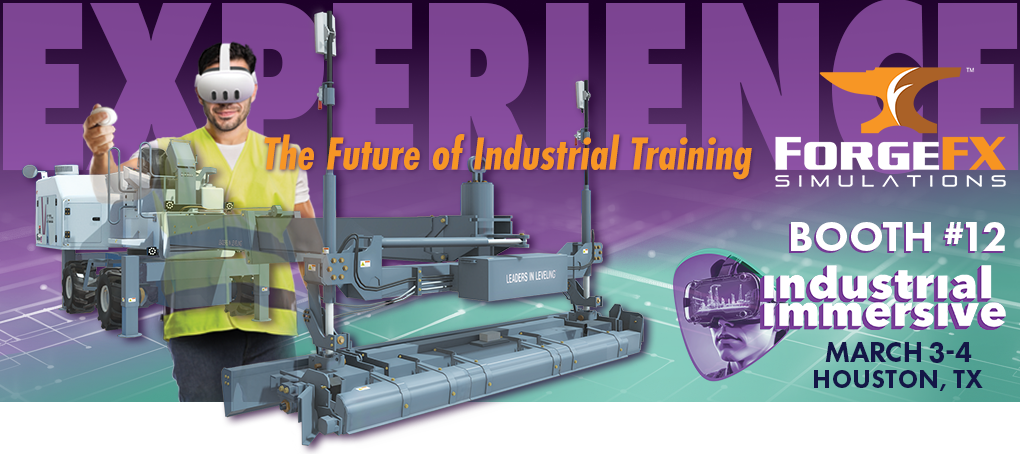
ForgeFX Simulations at Industrial Immersive 2025: Hands-On XR Training for the Future!

 🚀 Experience the Future of Industrial Training with ForgeFX! 🚀

We’re excited to announce that ForgeFX Simulations will be exhibiting at Industrial Immersive 2025, bringing our latest VR-powered workforce training solutions directly to you! Join us at Booth 12 on March 3-4 in Houston, TX, for an exclusive hands-on experience with our cutting-edge industrial training simulators.

Why Visit ForgeFX at Industrial Immersive 2025?

🔧 Interactive Demonstrations: Experience firsthand how our immersive simulations transform workforce training, making it safer, smarter, and faster across multiple industries.

🎯 Industry-Specific Solutions: Whether you're in manufacturing, construction, energy, or logistics, discover how our realistic XR training environments can enhance operational efficiency and safety.

📈 Proven Impact: Learn how Fortune 500 companies are leveraging AR, VR, and XR simulations to revolutionize workforce development and reduce operational risks.

💡 Expert Insights: Connect with the ForgeFX team to discuss the latest trends in simulation-based training, AI-driven learning, and spatial computing—and how these innovations can benefit your organization.


What You’ll See at Booth 12

At ForgeFX Simulations, we specialize in developing customized simulation-based training solutions that replicate real-world equipment, environments, and workflows. Our technology enables trainees to practice complex tasks in a risk-free, highly realistic setting, leading to better retention, improved performance, and enhanced workplace safety.

Here’s what you can expect: 

Live VR Training Demonstrations – Get hands-on with our latest immersive simulations. 

Real-World Case Studies – See how global leaders are implementing XR training solutions. 

One-on-One Consultations – Learn how to integrate simulation-based training into your workforce development strategy.

Join the Industrial Training Revolution

Industrial Immersive 2025 is the must-attend event for professionals looking to leverage XR, AI, and simulation technology to improve industrial training and workforce development. Don’t miss this opportunity to connect with industry pioneers and explore groundbreaking advancements in digital twins, spatial computing, and immersive learning.

📍 Westin Memorial City, Houston, TX
📅 March 3-4, 2025
📌 Booth 12 – ForgeFX Simulations
🔗 Learn more about the event and register: Industrial Immersive 2025

Join us as we redefine the future of industrial training! 

Thursday, May 09, 2024

Global VR Deicing Simulator

ForgeFX Simulations is proud to partner with Global Ground Support to develop their Global VR Deicer Simulator, developed for the Meta Quest platform, the immersive training simulator puts operators on-board one of three models of a high performing Global deicer trucks. Featuring a real-time physics-based weather and precipitation fluid dynamics engine, designed to prepare operators for the exact atmospheric conditions they'll encounter on the job, the deicing simulator empowers operators to master real-world challenges.

Global VR Deicing Simulator by ForgeFX Simulations

https://globalgroundsupport.com/simulator/

Wednesday, November 01, 2023

Global XR Conference 2023

If you're attending the Global XR Conference this year, please plan on attending the session that ForgeFX CEO, Greg Meyers, will be presenting, titled, Affordably Developing Custom VR Training Simulators. This session will discuss a number of strategies for developing VR training simulators affordably as well as provide a number of case studies of organizations the speaker has worked with to successfully develop VR training simulators.
https://www.youtube.com/live/6e79cHTRTMA?si=wektIcESpKET707

Tuesday, September 19, 2023

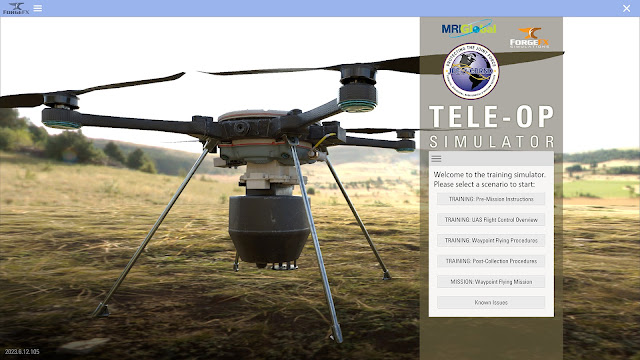
Unmanned Aircraft System (UAS) Training Simulator Delivered to JPEO-CBRND by ForgeFX Simulations and MRIGlobal

UAS simulator gives JPEO-CBRND the ability to deploy simulation-based training to operators to master the controls and process involved in operating a UAV.
ForgeFX Simulations Delivers UAS Training Simulator to JPEO-CBRND
This interactive 3D virtual training simulator is designed to instruct CBRND personnel in the remote operation of an Unmanned Aircraft System (UAS) from within a Nuclear Biological Chemical Reconnaissance Vehicle (NBCRV). Working directly with subject matter experts (SMEs) from the DoD and Teledyne FLIR, ForgeFX created digital replicas of their physical and virtual products, reproducing all the functions the physical objects perform. This simulator, running on a standard tablet computer, gives the JPEO-CBRND the ability to widely deploy simulation-based training to operators, who can master the complex controls and processes involved in operating a UAV and all of the onboard sensors it carries. 

 The simulator recreates a CBRND reconnaissance mission featuring an NBCRV equipped with a sensor suite array and two pods, each containing a UAS. The UAS in the simulator is an R80D Skyraider drone carrying a MUVETM B330 Continuous Biological Detector and Collector payload, both manufactured by Teledyne FLIR. The Skyraider is launched from the NBCRV and directed into an area suspected to be contaminated by airborne substances. Operated by means of the ATAK application running on a tablet computer inside the NBCRV, the drone’s sensor payload helps the CBRND personnel triangulate on the position, speed, and contents of airborne contamination. 

Tuesday, July 11, 2023

MRIGlobal and ForgeFX Simulations Partner to Advance CBRN Special Operations Simulator

The Joint Program Executive Office for Chemical, Biological, Radiological and Nuclear Defense (JPEO-CBRND) has selected MRIGlobal and ForgeFX Simulations to bring the latest advances in simulation-based training programs to its Nuclear Biological Chemical Reconnaissance Vehicle (NBCRV) technology and deployment strategies. As the military continues to modernize and upgrade its hardware and software capabilities, its training must keep pace to ensure warfighters remain at the top of their game. The newest installment to these programs will update the JPEO-CBRND’s Tele Operations Simulator for the modern UAS (Unmanned Aerial Systems) used by the military today. First produced in 2020, the Tele-Op Simulator is among a series of simulation-based training and visualization products that MRIGlobal and ForgeFX Simulations have collaborated on for the US Government. The original simulator includes a virtual Polaris MRZR equipped as an unmanned ground vehicle (UGV). Mounted with previous prototype Chemical, Biological, Radiological, and Nuclear (CBRN) detection equipment and activated with onboard controls, the UGV is piloted via a customized version of the ATAK (Android Team Awareness Kit) application. Using a module that recreates the ATAK interface, the simulator allows trainees to activate and remotely drive the virtual UGV across several square kilometers of virtual terrain, exactly as they would in the field. Read the full press release here: MRIGlobal and ForgeFX Simulations Partner to Advance CBRN Special Operations Simulator

Monday, August 01, 2022

Wednesday, June 22, 2022

OcuWeld Available on App Lab

We're excited to announce that OcuWeld, the welding training simulator that ForgeFX Simulations built for StrataTech Education Group, is now available for the Quest on Meta's App Lab!
https://www.oculus.com/experiences/quest/6904853139556100/


OcuWeld Provides Training in VR on:
• 19 different modules covering TIG, MIG, Stick, Flex-Core and more
• A specific welding process (e.g. The tools and method used)
• A particular weld position (e.g. A 45-degree pipe weld)
• And corresponding type of material (e.g. Stainless steel)

Sunday, March 24, 2019

JLG Partners with ForgeFX Simulations to Develop Virtual Reality Training Simulator

JLG® Industries, Inc., an Oshkosh Corporation company and a global manufacturer of aerial work platforms and telehandlers, will showcase its new AccessReady XR® Operator Training simulator at the ARA Show, February 18-20 in Anaheim, California, at booth #5441. This launch to the commercial market will offer JLG customers the ability to train and improve the skills of boom lift equipment operators in a safe, virtual environment.

JLG AccessReady XR provides virtual reality-based training for operators of all skill levels, with everything from controls familiarization to machine operation and advanced spatial awareness challenges. This type of immersive training optimizes the learning experience while preparing operators to efficiently use the controls and familiarize themselves with boom lift operation.

The simulator launch is the result of a year-long global pilot program that included introductions of the technology at numerous trade-show events, in addition to volumes of global customer feedback, designed to enhance the experience. The simulator was developed in partnership with ForgeFX Simulations, which specializes in 3D and visualization software.

“It’s been a privilege to pilot the AccessReady XR system for JLG this past year,” said Steve Wozniak, product support representative for Cloverdale Equipment Company. “My customers look forward to working with the VR kit at operator training classes. I’ve found it to be an extremely helpful training tool overall, but especially with my novice personnel. Putting them in the JLG VR system gives them real-world experience in a safe environment.”

“We are excited to bring this revolutionary virtual reality training program to our customers,” said Rick Smith, senior director, global product training for JLG Industries. “After years of testing, we feel this technology will help train boom lift operators faster and more effectively, which will significantly help to improve safety and job site performance.”

JLG is committed to helping customers meet and exceed new ANSI standards through machine design, safe use, and training. The AccessReady XR Operator Training simulator is the newest addition to the company’s growing training portfolio. This includes easy-to-access training courses to ensure operators and supervisors are compliant with standards.

Benefits of the JLG AccessReady XR Operator Training simulator include:
  • Safe environment for training operators
  • Increased “hands-on” controls training for reduced time to proficiency
  • Improved quality of practice time, allowing operators to experience real-life applications more quickly
  • Reduced trainee idle time to increase practice while evaluations are performed
  • Reduced evaluation time, since knowledge of the controls occurs faster
  • Real-time feedback to accelerate training knowledge
Other key features of the JLG AccessReady XR Operator Training Program include real-world controls, “virtual hands” (unique to JLG), a networked multi-user mode, multiple training environments (including proving grounds and construction sites), selectable virtual avatars for multi-user scenarios, an instructor-led mode, and tools to create unique password-protected scenarios and customized performance metrics.

The JLG AccessReady XR package includes:
  • 4′ JLG 800S platform with controls and foot switch
  • HTC Vive VR headset with headphones and Leap Motion camera
  • HTC Vive sensors and tracker
  • VR-ready PC pre-loaded with JLG AccessReady XR software
  • Keyboard with touch pad and monitor for PC
  • Portable cabinet for housing the PC and VR components
  • System setup and operating instructions
For more information on the JLG AccessReady XR Operator Training Program and how to purchase, visit www.jlg.com/ARXRFor more information about JLG, visit the website at www.jlg.com. For more information about ForgeFX Simulations, visit www.forgefx.com.

Press Release: https://www.jlg.com/en/news-events/press-releases/2019/accessready-xr-feb18

Tuesday, April 23, 2013

Shovel Operator Training Simulator Demo Video


ProMiner Shovel Operator Training Simulator Demo Video

The ProMiner Shovel Operator Training Simulator, a 3D simulator developed by ForgeFX for P&H Mining, increases your company’s bottom line by producing an extremely well trained workforce. Operators become experts in moving more material in less time, significantly increasing the mine’s productivity. The training simulator allows both novice and veteran operators to train in a safe virtual environment, where mistakes become valuable lessons instead of costly mishaps. Training simulators lead to less real-world machine downtime for operator training, and higher overall efficiency levels, by providing a realistic virtual training environment where techniques can be mastered quickly and safely.

ForgeFX, a proud partner of P&H Mining Equipment, a division of Joy Global Inc., specializes in the development of custom 3D training simulators.

www.forgefx.com Contact us on ForgeFX Get updates by liking us on Facebook Get updates on Facebook Get tweets by following us on Twitter Get tweets on Twitter Stay connected by following us on LinkedIn Connect on LinkedIn


Friday, April 19, 2013

Operator Training Simulator Supervisor Position Opening

Fircroft, a leading provider of technical recruitment services for the Oil and Gas industries, has an opening for an Operator Training Simulator Supervisor in Houston, Texas. The role is a full time contractor position, that requires 5+ years of Oil and Gas industry and Information Technology experience.

Job Description: Management of Operator Training Simulator (OTS) to ensure that all OTS trainers receive adequate training in all aspects of OTS operation, appropriate to their responsibilities and disciplines, so that the necessary level of competence Plant Operations and Maintenance personnel will be achieved. Ensuring information, data and systems contained in the OTS are accurate and 'up-to-date' with the LNG Plant equipment and processes. To develop training 'scenarios', training material, programs, schedules and delivery methodologies that ensure Plant Operations and Maintenance personnel are competent to perform their respective job/positions tasks and functions. This is a supervisory position, the incumbent is expected to orient, train and develop OTS Trainers on the team; provide appropriate coaching, guidance and supervision.

Full job description: Operator Training Simulator Supervisor

Get updates by liking us on Facebook  Get updates on Facebook  Get tweets by following us on Twitter  Get tweets on Twitter  www.forgefx.com  Contact us on ForgeFX

Friday, August 31, 2012

Flight Simulators Skyrocket

The demand, use, and adoption of flight simulators is skyrocketing.

The aviation industry has always been a leader in the use of training simulators, and they continue to push simulators to the forefront of training. A recent BBC New article, Flight Simulator Development Set to Soar, includes an interview with David Ownes, senior director of flight crew training at Airbus, who predicts the number of full-flight simulators will double in the next 10 to 20 years.
  • There are currently 900 full-flight simulators in the world, estimated to double by 2032..
  • By 2032, the number of jet airliners will double, to 40,000.
  • By 2032, 517,000 new pilots will require training.
"The demand for training seems destined to increase significantly over the next 20 years as air travel grows, and the full-flight simulator is a vital part in the support of this growth."
Globally, as airline travel is predicted to continue to increase over the next 20 years, the aviation industry is forecasting unprecedented growth. Manufacturers that provide training for operators, airlines that have their own training centres, and third-party training facilities all around the world are all scrambling to buy as many simulators as they possibly can at the moment.

Get Adobe Flash player
Interview with David Ownes, Airbus Senior Director of Flight Crew Training

Crash Shows Need For Simulators

A recent Air France crash, in which an Air Bus A330-200 jetliner plunged from 38,000 feet into the Atlantic Ocean, demonstrates the need for more realistic flight simulators that are capable of simulating the violent nature of aerodynamic stalls. A recent Bloomberg News article, Air France Crash Shows Need for Realistic Flight Simulators, reports that the FAA may soon require simulators to realistically portray stalls so that pilots experience realistic virtual portrayals of stalls in their training and learn how to react correctly. Simulators have the ability to recreate the surprise and confusion pilots face in real-life situations, a component that is critical to proper training.

South Africa Air Force Helicopter Simulator Cuts Costs

A recent Engineering News article, Helicopter Simulator to Boost South African Air Force Training While Cutting Costs, reports that Eurocopter recently unveiled the first full flight helicopter simulator in South Africa, a full motion simulator with six degrees of freedom, allowing it to completely reproduce the motions of a Eurocopter AS332 Super Puma helicopter. The simulator will provide valuable training as well as significantly cut the helicopter training costs, since training in the simulator costs approximately 25% of training in a real-world helicopter.

Aviation Growth Equates to Simulator-Based Training Growth

With the surge in growth of the aviation industry, the simualtor-training industry is set to follow in close succession. If, as expected, the number of jetliners swells to 40,000 by 2032, the there will be a need for about 517,000 new pilots in the next 20 years, and flight simulators will provide a considerable amount of the training they will require. Flight simulators allow pilots to train on a more frequent basis and for more specific maneuvers and emergency procedures, training that is essential when it comes to aviation safety. With the average flight simulator costing $25 million USD to purchase, and another $1 Million to maintain anually, it's estimated that the flight simulator market will be worth at least $25 billion USD over the next 20 years.

Friday, December 11, 2009

BCIT Launches The CUBE

British Columbia Institute of Technology Launches The CUBE: Centre for the use of 3D simulation technology, taking teaching and learning to a new level.

With a US$1 million grant from Lockheed Martin and $380,000 in software contributions from NGRAIN Corporation, BCIT has launched The Cube.


BURNABY, BRITISH COLUMBIA -- (MARKET WIRE) -- 11/02/09 -- It will transform the way instructors teach and the way students learn at BCIT. It will bring the workplace into the classroom and enrich curriculum - virtually.

The CUBE initiative places 3D simulations of expensive, rare, and leading edge equipment into the hands of BCIT students, anytime, anywhere allowing learners to explore complex components and systems in a 3D virtual world before they touch the real thing.

Read the entire press release

Tuesday, June 09, 2009

Adobe Success Story: ForgeFX: Interactive 3D Simulations

ForgeFX creates competitive advantage for itself and clients with Adobe Director and Adobe Shockwave Player software.

Adobe Success Story - ForgeFX - Interactive 3D Simulations

Whether they need to train employees how to accomplish mission-critical tasks or educate potential donors or customers, many organizations are tapping into the power of interactive 3D training simulations and role-playing games. By providing a simulated experience, organizations can help employees, customers, and others learn by doing without the high costs and risks of learning in the field.

ForgeFX relies on Adobe software due to its flexibility and ability to deliver a rich, high-performance user experience. Offering cross-platform offline executable deployment and online browser-based delivery with the Shockwave Player, Director applications can easily be viewed on any computer, enabling superior mass distribution. Users have the convenience of either online or offline content consumption with the ubiquitous Shockwave Player, already installed on more than 450 million Internet-enabled desktops.

Adobe Success Story - ForgeFX - Interactive 3D Simulations

One of the main benefits of Director over many other development platforms is its real-time 3D rendering engine. Because Director is a high-level development environment, as opposed to a custom low-level one-off 3D rendering engine, 3D rendering code is delivered out of the box, allowing developers like ForgeFX to concentrate on game and simulation logic. Director also enables ForgeFX to build simulations that include complex physics-based realism.

The new NVIDIA PhysX engine in Adobe Director 11.5 allows us to expand and build advanced dynamic motion and interaction into our simulations and games resulting in a richer user experience. Advanced physics, real-time 3D rendering, and a solid, mature platform with a rock-solid runtime engine are several factors that make Director our primary development platform.

Read the full article which discusses a couple of recent projects developed by ForgeFX using Adobe Director.